
What Is a Carbon Footprint and How Does It Affect Your Buildings?

More and more companies are calculating their carbon footprint — some because regulation requires it, others because their clients or their financing providers ask for it.
A significant part of that footprint is generated in buildings: the energy they consume for heating and cooling, lighting or running equipment translates into emissions that can be measured and reduced.
This article explains what a carbon footprint measures, how your buildings factor into Scopes 1, 2 and 3, which companies are required to calculate it, and where to start reducing it.
What Does a Company’s Carbon Footprint Measure?
A carbon footprint measures the greenhouse gas (GHG) emissions associated with a company’s activity. Not just CO₂: other gases too, such as methane or fluorinated gases, which are expressed in a common unit — CO₂ equivalent (CO₂e) — so they can be added together.
The calculation relies on emission factors: each unit of consumption (electricity, gas, fuel) is multiplied by a factor that converts that activity into emissions. The most widely used framework for classifying and calculating these emissions is the GHG Protocol (Greenhouse Gas Protocol), which organizes them into three scopes.
What Are Scope 1, 2 and 3 Emissions?
The GHG Protocol divides emissions into three scopes, based on their source and how much control the company has over them.
| Scope | Emission Type | Example |
|---|---|---|
| Scope 1 | Direct emissions | Gas combustion in boilers; company-owned fleet |
| Scope 2 | Indirect emissions from purchased energy | Electricity purchased from the grid |
| Scope 3 | Other indirect emissions across the value chain | Purchases, travel, waste, commuting |
Scope 1: Direct Emissions
These are emissions produced directly at the company’s own facilities, from sources it controls. In a building, the most common case is the combustion of natural gas or diesel in boilers, for heating or hot water. This scope also includes emissions from a company-owned vehicle fleet and refrigerant gas leaks from HVAC equipment.
Scope 2: Indirect Emissions from Purchased Energy
These are the emissions associated with the energy a company buys, mainly grid electricity. The company doesn’t emit them on-site, but they’re generated when that energy is produced. In many tertiary buildings, Scope 2 is the most significant scope, since electricity powers HVAC, lighting and most equipment.
Scope 3: Other Indirect Emissions Across the Value Chain
This scope covers the rest of a company’s indirect emissions — those that don’t depend directly on the company itself: purchased materials and services, employee commuting, business travel, waste management, or the use of products sold. It’s usually the broadest scope, and also the hardest to measure, since it depends on third parties.
How Do Your Buildings Affect Scopes 1, 2 and 3?
Buildings contribute emissions to all three scopes, though unevenly. The emissions that depend on a building’s own energy consumption are concentrated in Scopes 1 and 2.
| Emission Source | Scope | Example in Buildings |
|---|---|---|
| Gas or diesel boilers | Scope 1 | Heating and hot water from combustion |
| Refrigerant gases | Scope 1 | Leaks from HVAC equipment |
| Grid electricity | Scope 2 | HVAC, lighting, equipment |
| District heating or cooling | Scope 2 | Purchased thermal energy |
| Supplies and maintenance | Scope 3 | Contracted services and materials |
| Waste and water | Scope 3 | Building waste management |
Scopes 1 and 2 are where energy management has the most leverage, because cutting HVAC or electricity consumption directly reduces those emissions.
Does It Matter Whether You Own or Lease the Building?
Yes, although what determines which scope the emissions fall under isn’t ownership so much as control: who manages the equipment and who contracts the building’s energy supply.
If the company controls the equipment and pays for its own supplies, that building’s emissions fall under its Scopes 1 and 2, whether the building is owned or leased. If it doesn’t control them — for example, because energy is included in the rent, or the landlord manages it as a shared service — those emissions still count toward the company’s footprint, but are accounted for under Scope 3, as emissions from a leased asset.
The GHG Protocol calls this the operational control approach. It’s the most widely used, though not the only one available, so it’s worth deciding which approach applies and agreeing on it with the other party before calculating, to avoid double-counting emissions or leaving them out altogether.
How Do You Calculate the Carbon Footprint of Your Buildings?
The calculation follows a set sequence of steps:
- Define the boundary. Decide which buildings and which emission sources are included, and which scopes will be calculated.
- Gather consumption data. Collect electricity, gas, fuel, refrigerant top-ups and other supply data, by building and by period.
- Apply emission factors. Convert each unit of consumption into emissions using recognized, up-to-date factors. In Spain, MITECO (the Ministry for the Ecological Transition) publishes reference factors through the Carbon Footprint Registry.
- Add it all up in CO₂ equivalent. Combine all sources into a single unit to obtain the total footprint.
The quality of the result depends on the quality of the data. Utility bills let you calculate the annual total, but they don’t show which buildings, uses or equipment the consumption is concentrated in. Continuous measurement provides that breakdown and connects the footprint to the building’s energy efficiency: the same data used to calculate emissions can also be used to cut consumption.
Which Companies Are Required to Calculate Their Carbon Footprint?
Not every company is required to calculate its carbon footprint, but more and more are.
In Spain, Real Decreto 214/2025 (Royal Decree 214/2025) establishes this obligation for certain organizations. Broadly speaking, it affects companies that are already required to publish a non-financial information statement (EINF): large companies and public-interest entities that exceed certain size thresholds. It also applies to government ministries and other state public-sector entities.
For companies subject to the obligation, the royal decree requires calculating Scope 1 and 2 emissions every year and drawing up an emissions reduction plan with a quantified target and a minimum five-year horizon. Scope 3 is voluntary for companies; for the state public sector, it will become mandatory starting with the 2028 footprint.
Third-party verification isn’t mandatory, unless the organization registers its footprint with the Registry. The footprint and the reduction plan must be published in an accessible way — for example, on the company’s website; including them in the EINF satisfies that requirement.
Since the deadlines follow the non-financial reporting regulation’s timeline, which is currently under review, it’s worth checking the specifics of each case rather than assuming. Even without a legal obligation, clients, investors and tenders are asking for this figure more and more often.
How Can You Reduce the Carbon Footprint of Your Buildings?
Reducing a building’s footprint mainly comes down to cutting energy consumption and Scope 1 and 2 emissions. Matching HVAC operation to actual usage, upgrading lighting, replacing combustion equipment with electric alternatives, or adding renewable energy are some of the usual routes.
Every building starts from a different situation, so the measures with the biggest impact vary case by case. We’ve brought together the main ones in How to reduce your company’s carbon footprint.
From Measuring Your Carbon Footprint to Acting on Your Facilities
Calculating your carbon footprint shows how much the company emits and where those emissions come from. That figure doesn’t reduce them on its own — the reduction happens when it translates into decisions about the facilities.
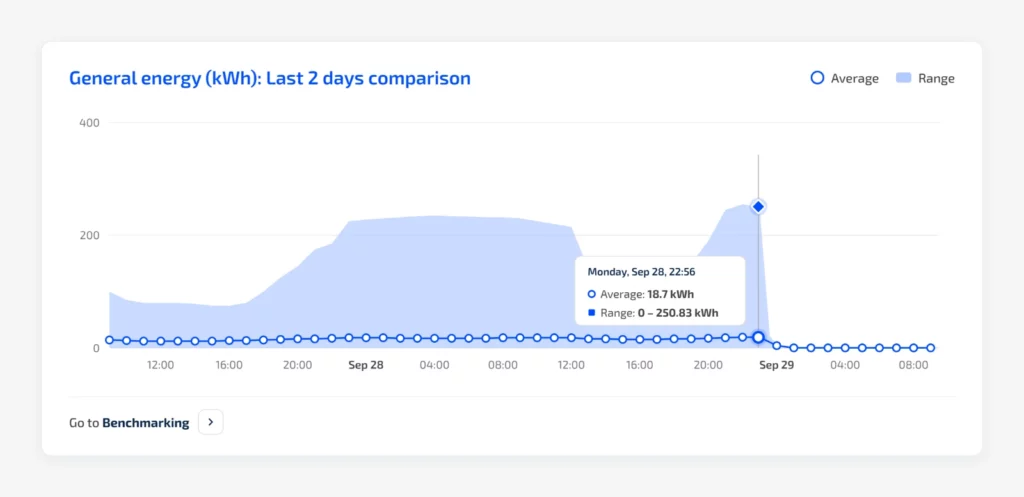
This is where energy management connects with the footprint. An EMOS (Energy Management and Optimization System) is a layer that brings together monitoring, control, operation and optimization of energy. Unlike a system that only logs consumption, or a BMS focused on a single building, OTEA — the EMOS platform developed by EcoMT — centralizes consumption data from one or several sites and makes it possible to act on the equipment: adjusting setpoints, detecting deviations and correcting out-of-hours consumption. With IoT applied to energy management, these actions are carried out on the facilities with no need for site visits.
In Scopes 1 and 2, every kWh you stop consuming cuts both the bill and the emissions at the same time, so cost savings and decarbonization are driven by the same actions.
OTEA provides the measured, traceable consumption data that the footprint calculation relies on, together with the ability to act on equipment to cut the emissions tied to that energy. If you’d like to see how it fits your case, you can get in touch with the EcoMT team

Recommended for you



You deserve a facility management system that works with you
Request a free demo and discover how other maintenance, sustainability, and energy efficiency teams are achieving real results. No unnecessary complexity. Just a clear roadmap designed to scale with you.




