
What is energy efficiency and how is it calculated in businesses?
Currently, energy efficiency has become a priority issue for any company seeking to cut operating expenses and be more environmentally friendly. We should not confuse it with simple energy saving; While the latter only tries to consume less, energy efficiency seeks to get the most out of each kilowatt without giving up productivity or well-being in the facilities.
Understanding how it works and measuring it correctly allows you to develop a business strategy that makes better use of your resources.
What is energy efficiency?
Energy efficiency consists of making better use of energy to achieve the same results or services while spending less. In practice, it means that you can continue manufacturing the same products, maintaining the same level of comfort in the offices, or providing the same services, but with lower energy consumption. It is getting more value from every euro invested in energy, allowing companies and buildings to waste less while maintaining their normal functioning.
In daily business life, energy efficiency touches all aspects: from office air conditioning and lighting to production processes, cooling systems and hot water management. Its objective is threefold: reduce costs, emit less CO₂ and ensure that energy resources continue to be available.
Difference between energy efficiency and energy saving
We often use these terms as if they were the same, but there are quite clear differences between them. Energy savings simply consists of using less energy by changing your habits, even if that means losing some comfort, services or even reducing production. For example, turning off the heating even if it is cold or raising the cooling setpoint (e.g., from 22 to 25°C in summer) are savings measures that you will notice in your well-being.
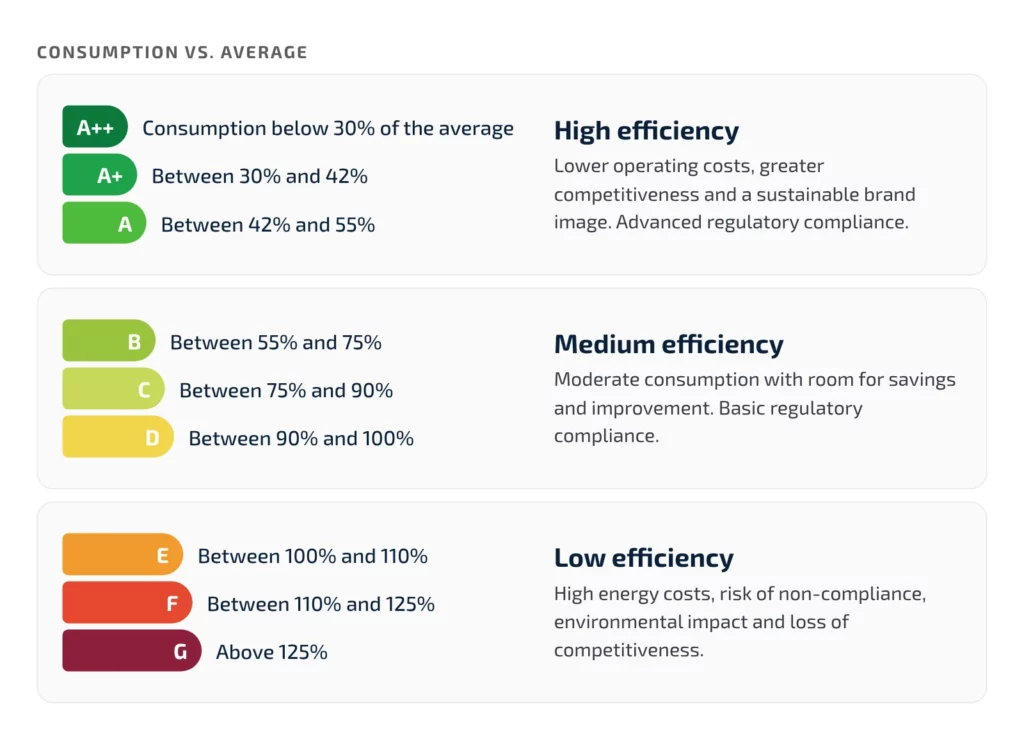
Energy efficiency, on the other hand, seeks to maintain low consumption while continuing to do your usual activities without affecting your comfort or production. It is achieved by installing systems and technologies that make better use of energy. An example would be changing an old air conditioner for a class A one, which cools the same but consumes much less.
In short: energy savings = consuming less, while energy efficiency = making better use of what you consume.
How is energy efficiency calculated in companies?
Technically, it is comparing how much energy you consume with how much performance you get. But there is a trick to that, because the performance is not always the same.
If you have a company in Madrid, winter requires more heating. Someone in Malaga will not have that problem. Hours also count: an office that operates 24 hours a day does not behave the same as one that closes at 6 p.m. How many people are inside, what the building is like, when it’s hot or cold.
The basic calculation compares consumption with the activity carried out, but for it to make sense you must normalize that data. That is,adjust them according to climatic factors (degree-days), actual occupancy (hours and number of users), and building characteriztics. This way, you can compare consumption from two different years and see if you really improved efficiency or simply had more favorable weather.
For this reason there are specialized tools, such as Energy Management Systems (EnMS), which collect information from smart meters and sensors to analyze whether you are spending what you should or if there is room for improvement.
Key energy efficiency indicators
There are several indicators that allow us to measure and compare how energy efficient you are:
• Energy intensity (EI): It relates what you consume to what you do, and is measured in kWh/m²/year for buildings or kWh/metric ton in industries. An office that uses 150 kWh/m²/year is more efficient than another that needs 300 kWh/m²/year for the same thing. This information allows you to compare yourself with others in the sector.
• Primary energy consumption: Measured in kWh/m²/year, it includes both renewable and non-renewable energy, taking into account what is lost when generating and transporting it.
• CO₂ emissions: In kg/m²/year, indicate the environmental impact of your consumption.
• Load factor: Measures how stable your energy consumption is (relationship between average consumption and maximum peak). A high factor means constant consumption and good use of the contracted power. A low factor indicates occasional spikes in demand, forcing you to pay for underutilized capacity most of the time.
• Power factor (cos φ): Measures the efficiency of your electrical installation. If it is less than 0.95, you generate reactive energy that does not produce useful work, but penalizes your bill. Improving this factor by installing correctives (capacitor banks) directly reduces the charge month by month.
Why opt for energy efficiency in buildings and commercial premises
• Reduction of expenses day by day: Implementing energy efficiency measures reduces electricity and gas costs, while water savings (drinking water and domestic hot water) reduce both water bills and the energy consumption associated with its pumping and treatment. This combined savings improves your profitability.
• Advantage over competitors: If you spend less on operations and implement measures to reduce the carbon footprint of your company, you can offer more attractive prices and attract customers who value sustainability. In the long term, your position in the market is strengthened.
• Less dependence on energy fluctuations: By consuming less, you are not affected as much by increases in energy prices, which allows you to maintain budget control regardless of market instability
• Financial aid: There are subsidies, tax advantages and financing on favorable conditions for energy efficiency projects, which makes initial investments more bearable.
• Better brand image: Serious investors, clients with purchasing power, the talent you are looking for: they all prefer companies committed to sustainability. It’s not marketing, it’s business reality.
Energy efficiency as the basis of business energy management
Energy efficiency is not something that is done once and that’s it. It is the foundation on which a complete continuous energy management system is built. While efficiency gives you a snapshot of the current state, modern management systems go much further: they monitor in real time, automatically detect inefficiencies, predict problems before they occur, and adjust equipment without manual intervention. That’s what transforms data into real savings.
The journey begins with obtaining an energy performance certificate. It gives you the initial photo, the baseline from which you start. But a photo, no matter how good it is, is not enough if you want continuous results.
Next is constant visibility. Real-time monitoring systems show you exactly how you are using energy at all times, detecting anomalous behavior instantly.
But here comes what really changes everything: automation of buildings and facilities allows systems to automatically adjust air conditioning, lighting and other equipment according to real needs, without constant supervision.
The IoT sensors are what constantly collect that information, integrating perfectly with what you already have installed. And the EMS (Energy Management System) platforms centralize everything, allowing you to manage several sites from a single control panel.
What many companies overlook is predictive maintenance: detecting problems before they happen, fixing equipment before it breaks down completely. This extends its useful life and avoids those emergency repairs that involve unforeseen expenses.
When you combine all these pieces, energy efficiency stops being a theoretical objective and becomes a real driver of competitiveness, profitability and sustainability. It’s not magic, it’s simply using available technology intelligently.

Recommended for you
You deserve a facility management system that works with you
Request a free demo and discover how other maintenance, sustainability, and energy efficiency teams are achieving real results. No unnecessary complexity. Just a clear roadmap designed to scale with you.




