
What is an energy management and optimization system?

Energy management has changed radically in a very short time. A few years ago, the job basically consisted of monitoring what we spent and trying to understand the bills. Today, that is insufficient. Modern management has transformed into a strategy that mixes data analysis, automation and prediction.
This is where EMOS (Energy Management and Optimization Systems) come in. They are not a simple software update; They represent a new generation of platforms designed not only to understand consumption, but to actively and continuously optimize it.
Unlike traditional systems, which were limited to monitoring, an EMOS makes decisions. Detect inefficiencies in real time, simulate what would happen in different scenarios and propose concrete actions. And, in a context of volatile prices and increasingly strict regulations, companies need tools that allow them to transform their relationship with energy, not just measure it.
What is an EMOS
Let’s start with the fundamentals. An EMOS or Energy Management and Optimization System is basically the energy brain that your building needs. It is a platform that not only monitors how much you spend, but also learns from your consumption patterns, predicts what is going to happen and makes automatic decisions to save energy. The difference with traditional systems is radical: while these are limited to showing you graphics, an EMOS acts directly on your facilities.
And how does it do this? Well, connecting absolutely everything: from the IoT sensors that you have distributed throughout the building to the air conditioning systems, including lighting and production equipment. Everything is part of an ecosystem where each element is adjusted thinking about the whole. The energy management and optimization systems not only understand what is happening right now with your consumption, they also know what is going to happen in two hours, tomorrow or next week.
The architecture of these systems is based on four basic elements that work together: collect the data, process it with machine learning algorithms, act automatically and present the results to you in very visual panels. Thus, anyone can interpret the information without technical complications.
How an EMOS works
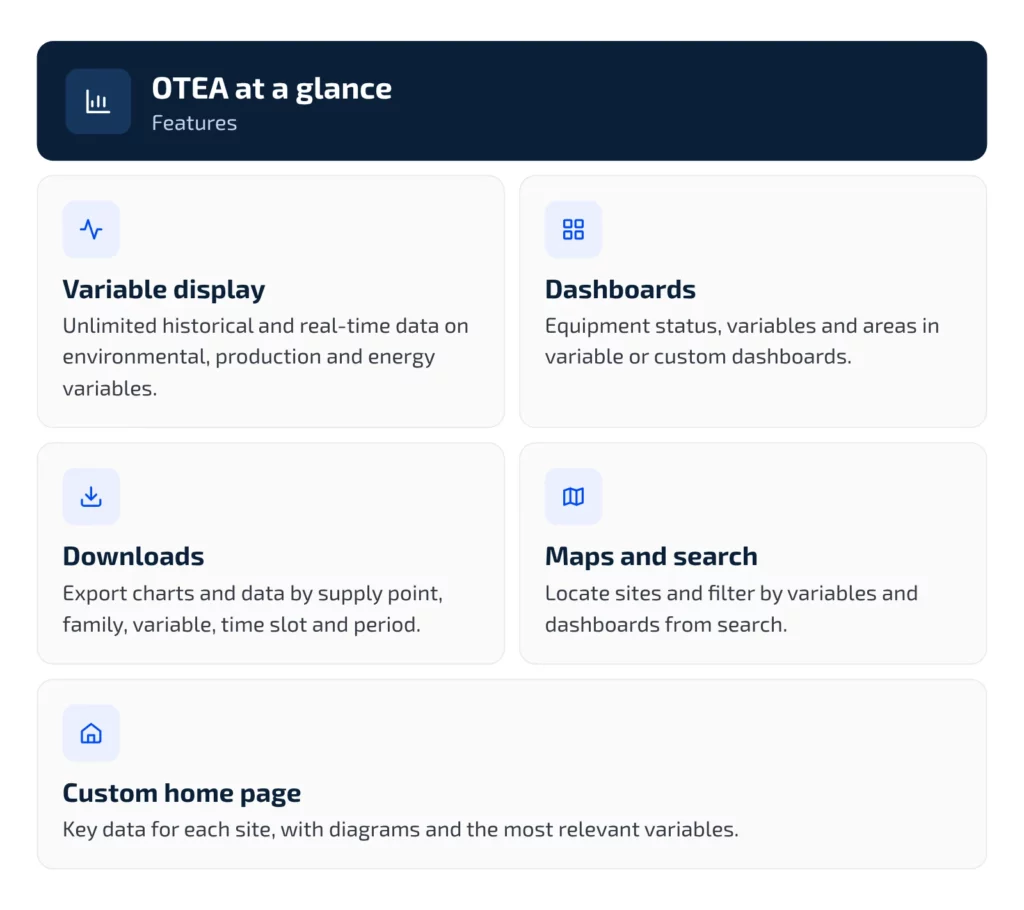
So that you can clearly see the real scope of an EMOS, here is the breakdown of its operation step by step.
Capture and centralization of energy data
The first mission of EMOS is to bring order. It acts as a command center that processes information from IoT sensors (consumption, temperature, occupancy, light…) to deploy a smart building automation. Whether you are starting from scratch or need to integrate with legacy systems (such as a BMS or SCADA), EMOS connects IoT sensors, HVAC equipment, BMS, SCADA, production systems or solar installations through protocols such as Modbus, BACnet, MQTT or REST API, unifying all information on a single platform. This integration layer eliminates silos and allows you to manage heterogeneous installations, preventing you from having isolated or duplicate data.
Therefore, the EMOS acts as that central point where all this data begins to make sense. It doesn’t matter if you have equipment from five different manufacturers or that some systems are 20 years old… the system understands them all and centralizes all the information on a single platform. This is especially useful when you have facilities with older equipment mixed with new technology, because it allows you to move toward a truly smart building model without having to replace the entire infrastructure.
Advanced analysis and intelligent modeling
The next step is predictive analysis. Once the information is centralized, EMOS applies machine learning algorithms to analyze the historical behavior of your installation and detect patterns that would go unnoticed in manual management: such as that 23% increase in consumption in the west zone when there is a north wind, or the load peaks on Monday mornings because all the equipment starts at the same time after the weekend.
But the system’s capacity goes further. EMOS generates a digital twin of your installation, a virtual replica that allows you to simulate operational scenarios without intervening in the physical infrastructure. What would happen if I changed the start time of the machines? What if I lower the temperature by two degrees in the warehouse? EMOS simulates these scenarios and tells you exactly how much you would save, without risking anything.
Automation and control in real time
And we come to the part where an Energy Management and Optimization System demonstrates its true value: acting on its own. You don’t need to be constantly adjusting parameters, the system does it only based on what it has learned. If it detects that a room is empty, it lowers the air conditioning. If you see that a peak hour with an expensive electricity rate is approaching, you begin to reduce non-critical consumption half an hour before. Everything automatic, everything in real time.
Integration with building automation systems allows EMOS to have direct control over HVAC equipment, lighting, pumps, compressors… any equipment that consumes energy. Adaptive algorithms continually adjust the parameters so that everything works at the right point of efficiency. No more, no less.
Predictive optimization and energy simulation
The most advanced EMOS go one step further and begin to anticipate what is going to happen. They analyze historical data, take into account the weather forecast, review occupancy calendars, production plans… and with all of this they predict how much energy you will need. This way they can prepare the installation in advance. For example, if they know that tomorrow is going to be very hot and you have an event with 500 people, they start cooling the building first thing in the morning taking advantage of the cheaper nightly rates.
Again, energy simulation allows you to play “what if” without consequences. Is it worth changing staff schedules? What if I install solar panels on the south roof? How much would you save with a new heat pump? The system gives you concrete answers with real numbers, not vague estimates.
Advanced visualization of energy data
It’s no use having all this data if you don’t understand it later. That is why modern EMOS put a lot of emphasis on displaying information in a clear and useful way, with panels that adapt to each role: management sees high-level KPIs and savings in euros, operations controls the overall performance of facilities and maintenance or the facility manager accesses the details of each piece of equipment, all in real time and updated to the second. Automatic reports are another strong point. The system generates personalized reports without you having to waste hours collecting data, which makes it easier to measure energy efficiency in smart buildings and clearly communicate the results to each area of the organization.
Alert management, proactive maintenance and regulatory compliance
An EMOS does not wait for equipment to break down. If it detects that a compressor is consuming 15% more than normal, it notifies you; If it sees that you are about to exceed the contracted power, it takes measures to avoid penalties, sending intelligent alerts to the right person at the right time. Predictive maintenance changes the rules of the game: instead of changing filters every
We must also take into account regulatory compliance, which is increasingly demanding. The EMOS automatically records all the data requested by the audits, generates reports ready for ISO 50001 and provides the necessary information for the calculation and monitoring of the carbon footprint, facilitating compliance with European directives and frameworks such as the EED, the EPBD, the BACS requirements or the EU Taxonomy, without having to reconstruct the data by hand in each energy audit.
Main advantages of an EMOS
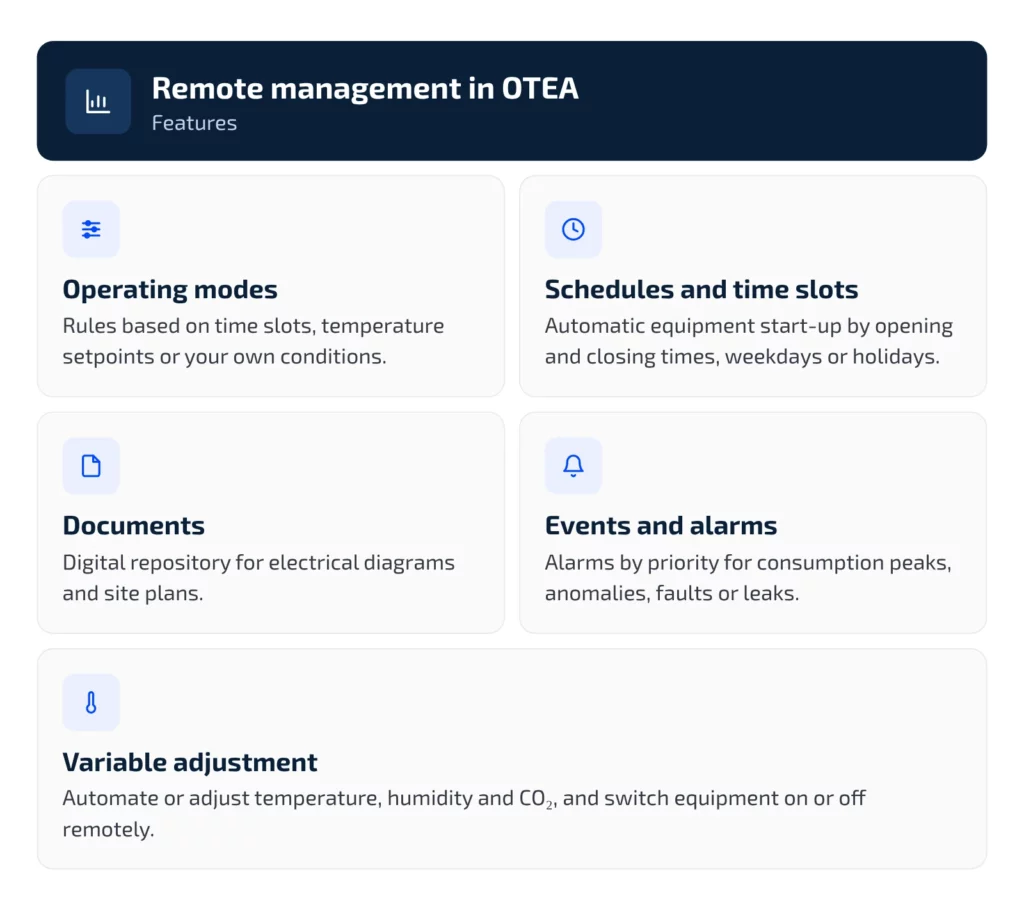
If you are wondering what you really gain from implementing an EMOS, let’s start with the most important thing: the direct impact on your bottom line.
Significant reduction in energy consumption
Let’s be clear: a well-implemented EMOS reduces consumption between 15% and 30%. These are not numbers pulled out of our sleeves, they are what we see in real facilities and what reference institutions support.
In Spain, the IDAE (Institute for Energy Diversification and Saving) points out that the implementation of automated management and control systems allows achieving savings of more than 20% on the energy bill. At a continental level, the European standard UNE-EN 15232 calculates that going from a building without control to one with advanced technical management reduces primary energy consumption by up to 30% in commercial buildings and offices.
How is it achieved?
Eliminating all those consumptions that do not contribute anything, adjusting schedules and fine-tuning parameters. The system finds savings opportunities that have gone unnoticed for years. And the best thing is that it maintains those savings over time, adapting to changes without you having to be on top of it monitoring each switch.
Improved comfort and productivity
Many people think that saving energy means being cold in winter and hot in summer. Nothing could be further from the truth. A well-configured EMOS improves comfort because it keeps conditions more stable, without those peaks and valleys that cause users to complain. Anticipates needs and responds quickly to changes. The result is happier and more productive employees, or more satisfied customers if we are talking about a hotel or a business.
Reduction of operating and maintenance costs
The savings go far beyond the electricity bill. Energy management and optimization systems drastically reduce maintenance costs by anticipating problems and optimizing interventions. If your equipment works more efficiently, it wears out less and lasts longer. Unforeseen breakdowns practically disappear thanks to predictive maintenance.
Data-driven decision making
No more making decisions by eye or based on intuition. With an EMOS you have real data, deep analysis and precise simulations. Do you need to justify an investment in new equipment? You have the numbers. Do you want to try a new operating strategy? First you simulate it. This analytical capacity is essential to implement strategies to reduce the company’s electricity consumption that really work.
Sustainability and carbon footprint reduction
Every kilowatt you save is CO2 that you do not emit. An EMOS not only reduces your environmental impact, it also documents it with millimeter precision. You can demonstrate with verifiable data how many tons of CO2 you have stopped emitting, information that is increasingly valuable for investors, clients and society in general. It is no longer enough to say that you are sustainable, you have to prove it with numbers.
Scalability and adaptability
An EMOS grows with you. You start with one building and when you see the results, you extend it to the rest of your assets. The modular architecture allows you to add new facilities, integrate additional systems and expand functionalities as you need them. It is not a rigid solution that becomes obsolete, but a platform that evolves with your organization.
Differences between an EMS (Energy Management System) and an EMOS
Seeing the data is not the same as acting on it. Discover in this comparison table why an EMOS goes one step beyond the EMS traditional to maximize your savings.
| Feature | Traditional EMS | EMOS |
|---|---|---|
| Primary Focus | Monitors and reports consumption | Actively optimizes and predicts consumption |
| Capacity analytics | Basic trend analysis | AI and machine learning for deep analysis |
| Automation | Little or simple rule-based | Intelligent automation that learns and adapts |
| Integration | Connects with systems main | Full integration with IoT and any system |
| Prediction | Practically zero | Accurate predictions with multiple variables |
| Optimization | It tells you what to do, you do it | Automatically optimizes in time real |
| Maintenance | Notifies you when something fails | Predicts failures before they occur |
| Simulation | Very basic or non-existent | Digital twins and simulations Complex |
| Customization | Limited configuration | Completely adapts to your installation |
| ROI | You recover your investment in 1-3 years | You recover your investment in 6-18 months |
| Complexity of implementation | Easy installation | More complex but with much more support |
| Scalability | Grows with difficulty | Designed to grow without limits |
EMOS applications in different sectors
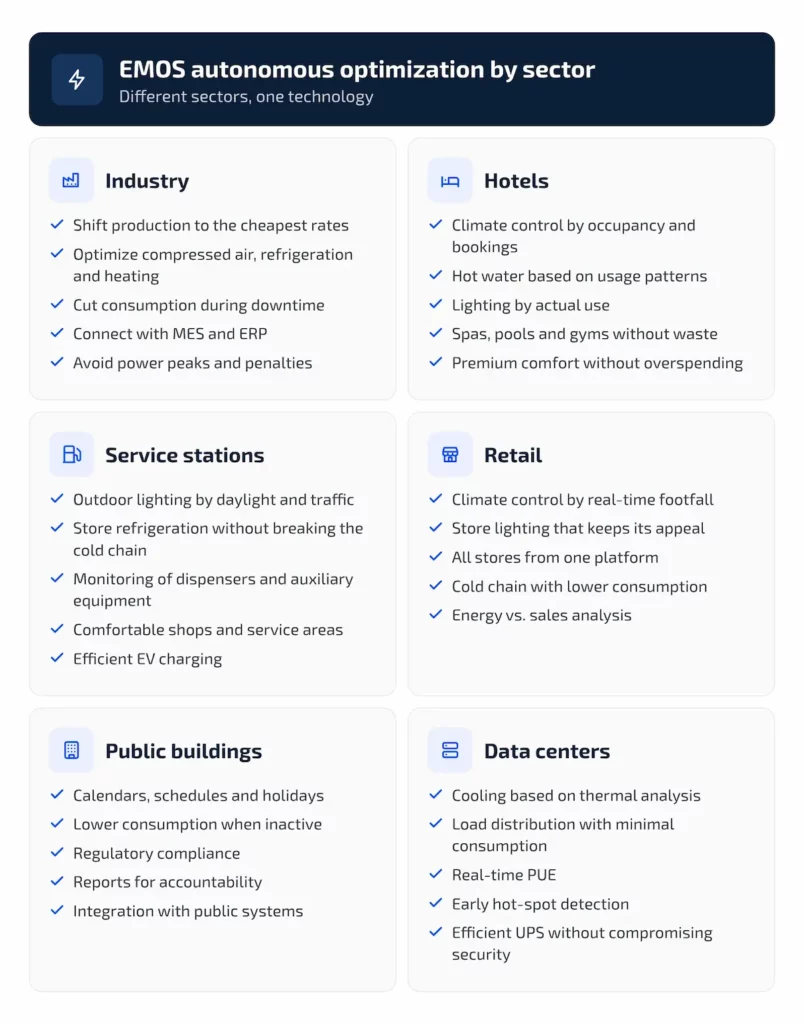
Let’s now see how EMOS autonomous optimization fits the unique needs of each industry to maximize savings and sustainability:
Industrial Sector
Factories and industrial plants are where an EMOS demonstrates its full potential:
- Intelligent synchronization: adjust production processes to take advantage of the cheapest electricity rates.
- Management of auxiliary services: optimizes compressed air (one of the largest hidden consumers), industrial refrigeration and heating.
- Production lines: detects and eliminates consumption during downtime that previously went unnoticed.
- Full integration: connects with MES and ERP for a complete view of efficiency.
- Demand control: avoid those power peaks that generate huge penalties.
Hotel Sector
Hotels have very variable energy needs and an EMOS manages them perfectly:
- Smart climate control: adjusts the temperature according to actual occupancy and future reservations.
- Optimized hot water: learn usage patterns and prepare just what you need.
- Adaptive lighting: manage common areas and rooms according to actual use.
- Special zones: control spas, pools and gyms without wasting energy.
- Premium experience: customize comfort for VIP guests without overspending.
Service Stations
A sector with tight margins where every euro counts:
- Outdoor lighting: adapts to natural light and real traffic.
- Efficient stores: optimize the refrigeration of products without breaking the cold chain.
- Complete monitoring: monitor dispensers and auxiliary equipment.
- Adjusted air conditioning: maintains comfort in shops and service areas.
- Electric chargers: manage vehicle charging by maximizing efficiency.
Retail Sector
The commerce needs to attract customers while keeping costs under control:
- Dynamic air conditioning: adjusts to the number of clients in real time.
- Commercial lighting: optimizes consumption without losing visual appeal.
- Multi-store management: control all branches from one platform.
- Food refrigeration: maintains the cold chain optimizing consumption.
- Cross analysis: relates energy consumption to sales to find the optimal point.
Public Buildings
The administrations have the responsibility to set an example:
- Management by calendars: adapts to variable schedules and holidays.
- Vacation periods: automatically reduce consumption when there is no activity.
- Regulatory compliance: guarantees compliance with all legislation.
- Full transparency: generate detailed reports for accountability.
- Administrative integration: connects with municipal or regional systems.
Data Centers
Where every watt counts and uptime is an absolute priority:
- Optimized cooling: Uses advanced thermal analysis to cool just as much as needed.
- Dynamic loads: distributes the work minimizing consumption.
- PUE in real time: monitors efficiency down to the second.
- Hot spots: detects and prevents them before they become a problem.
- Efficient UPS: manage power systems without compromising security.
In the end, the sector doesn’t matter. If such different sectors are betting on the same technology, it is because the reality of the market has pushed us all here. It is the logical and natural step.
Why are EMOS the future of smart energy?
Evidently, EMOS have not arisen by chance. They are the natural response to a world that has changed radically in recent years. Digitalization is no longer optional, it is the basis of any modern operation. And when you put together IoT sensors everywhere, virtually unlimited cloud processing capacity, and artificial intelligence that actually works… that’s when EMOS make all the sense.
But technology is only part of the story. European directives are increasingly stricter and sustainability requirements are no longer declarations of intent but have become legal obligations. You can no longer say that you will be more efficient “someday.” You need tools that allow you to deliver today and show that you are doing it.
And then there are the stakeholders. Investors who want to see real commitments to sustainability. Customers who choose suppliers based on their carbon footprint. Employees who prefer to work in responsible companies. An EMOS allows you not only to be more sustainable, but to demonstrate it with data that no one can question. This opens doors to green financing, improves your brand image and attracts talent.
The energy model is also changing by leaps and bounds. You are no longer just a passive consumer paying the bill. Now you can generate your own energy, store it, sell it, participate in flexibility markets… The scenario is much more complicated and you need systems capable of optimizing all these variables at the same time. An EMOS helps you find the optimal balance between generation, storage, efficient consumption and market participation.
But how do you take the step and apply this technology so that it really works in your favor?
OTEA: how an EMOS can transform the energy management of your company
OTEA has been recognized as EMOS in Gartner’s Market Guide, and that is no coincidence. We have been developing an energy management platform for years that goes far beyond the typical monitoring system. OTEA thinks, learns and acts so that you don’t have to pay attention to every kilowatt.
Do any of these situations sound familiar to you? Electricity bills that don’t stop going up and you don’t really know why. Sustainability reports that require weeks of work collecting data from a thousand different sites. Equipment that fails when you least expect it and leaves you stranded. Energy audits that always catch you on the wrong foot… If you have nodded your head, you need an EMOS like OTEA.
Our platform adapts like a glove to each sector. It doesn’t matter if you have a factory with complex processes or a chain of stores spread throughout Spain. The implementation is modular, so you can start with a small pilot to see results and then grow according to your needs and budget. The normal thing is to recover the investment between 6 and 18 months, then everything is net savings.
But OTEA is not just technology. It is a team of people who understand energy and who accompany you throughout the process. From the initial analysis to see where your savings opportunities are to continuous optimization when everything is already working. We don’t sell you software and disappear, we are with you to make sure you capture every euro of savings possible.
The time has come to take the step. In a world where energy is increasingly more expensive and sustainability requirements are stricter, having an EMOS like OTEA is not a luxury, it is a necessity. It is the difference between always being behind, putting out fires, or anticipating and leading change in your sector.

Recommended for you

You deserve a facility management system that works with you
Request a free demo and discover how other maintenance, sustainability, and energy efficiency teams are achieving real results. No unnecessary complexity. Just a clear roadmap designed to scale with you.




