
What is an energy monitoring system and how does it work in businesses?
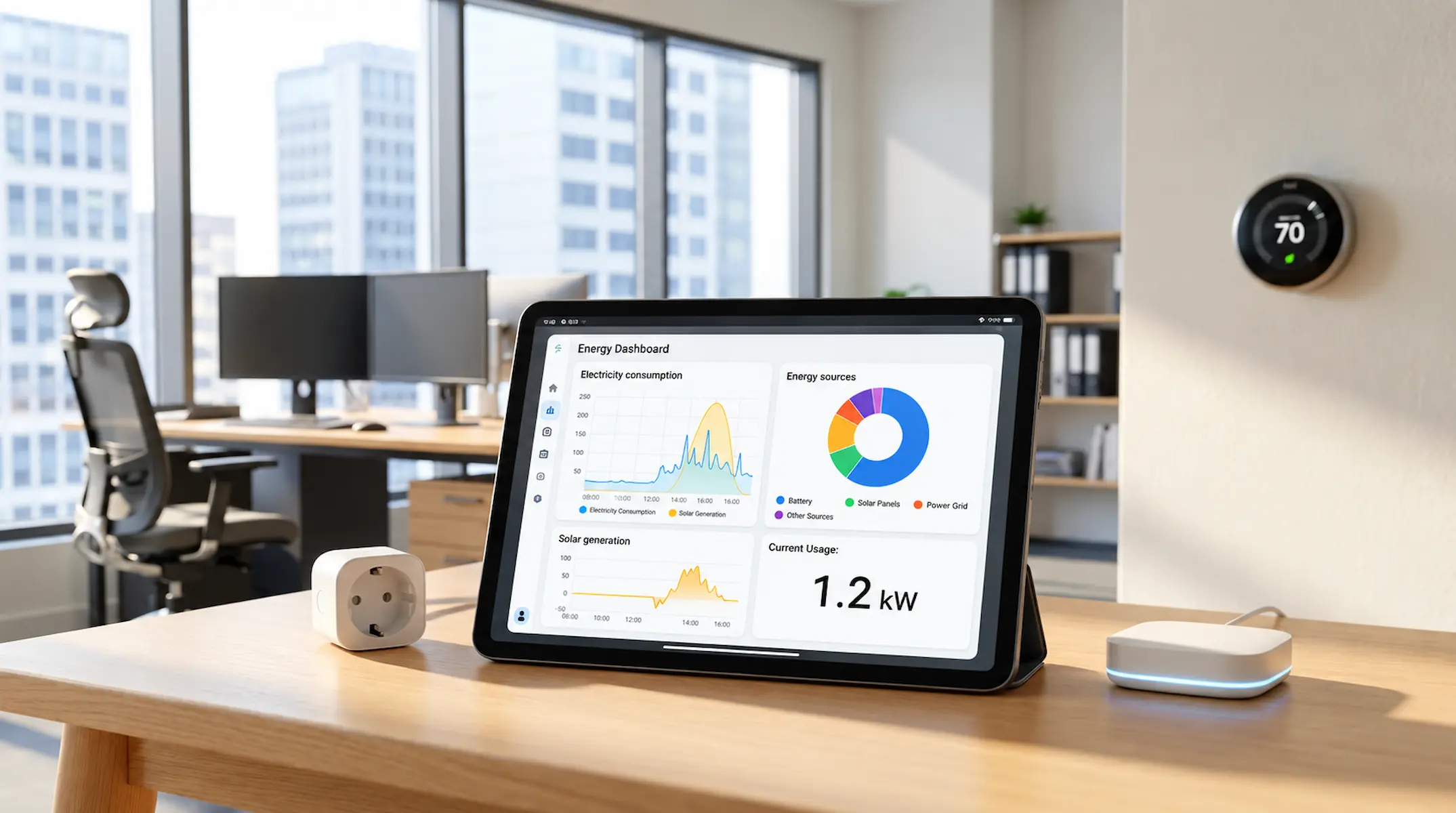
If you’ve ever looked at your electricity bill and wondered exactly where all that money goes, this section is for you. Energy monitoring is the answer to that question: it allows you to see in detail where, when and how energy is consumed in your company. It’s not a trick, it’s just having the right data in your hand.
Continue reading and find out with us what an energy monitoring system is and how it works in your business.
What is an energy monitoring system?
Think of an energy monitoring system as a technological tool designed for you, with the aim of measuring, collecting, analyzing and visualizing data on the energy consumption of your facility, building or set of assets in real time (or in very short intervals).
The big difference with traditional meters (which only tell you the total consumption at the end of the month) is that these systems give you a complete x-ray: you will know how much energy you consume, exactly where that consumption occurs within your company and at what times of the day, week or year it occurs.
Monitoring your energy consumption is the first essential step for any efficiency strategy you want to apply. It is the only way for you to understand the real energy behavior of your facilities and detect patterns, inefficiencies and opportunities for improvement that would otherwise remain invisible to your eyes.
What is energy monitoring used for in companies
Forget about seeing this as a simple technical installation; It is a tool that will give you real and practical advantages from the first moment:
- Total control over your energy consumption: It allows you to centrally manage the main areas of energy consumption of your company, being able to control up to 80% of consumption in facilities with advanced BACS systems and high continuous occupancy area.
- Identification of inefficiencies: It will become your best “snitch” to detect equipment that consumes more than normal, energy leaks, systems that stay on outside your working hours or machines that are not performing as they should. You can complement it with a energy audit for a thorough diagnosis.
- Reduction of operating costs: By knowing the details of your consumption, you can apply surgical corrective measures that will end up generating savings on your bills.
- Decision making based on real data: Monitoring changes the way you manage: you go from making intuitive decisions to making decisions based on accurate and updated information.
- Regulatory compliance: It makes it easier for you to comply with regulations such as the Regulation of Thermal Installations in Buildings (RITE) and other requirements, in addition to facilitating certifications such as LEED.
- Early fault detection: Allows you to identify strange behaviors that are usually the prelude to a technical failure, helping you avoid costly downtime or excessive consumption due to malfunctions.
How an energy monitoring system works
The operation of your measurement system follows a logical sequential process that transforms the data into useful management information:
- Installation of measuring devices: The first thing is the hardware. smart meters, power quality analyzers, IoT sensors and meters are placed in your key points (lighting, air conditioning, critical machinery, production processes).
- Automatic data collection: These devices capture information in real time about your electricity consumption, active power, current, power factor, voltage, temperature and other parameters.
- Data transmission to the platform: The information does not remain on the device. It is sent using communication protocols (such as Modbus, LoRaWAN, NB-IoT or LTE) through gateways and dataloggers to centralized systems in the cloud so that you can access them.
- Analysis and processing: This is where artificial intelligence comes in. Management platforms process your data with algorithms, identify consumption patterns, compare periods, detect anomalies and generate reference baselines so you know what is “normal” in your activity.
- Visualization and alert generation: Finally, you see the results in customizable dashboards, easy-to-understand graphs and automatic reports. In addition, the system sends you alerts if the limits are exceeded or something strange happens in your installation.
Technologies that intervene in your energy monitoring
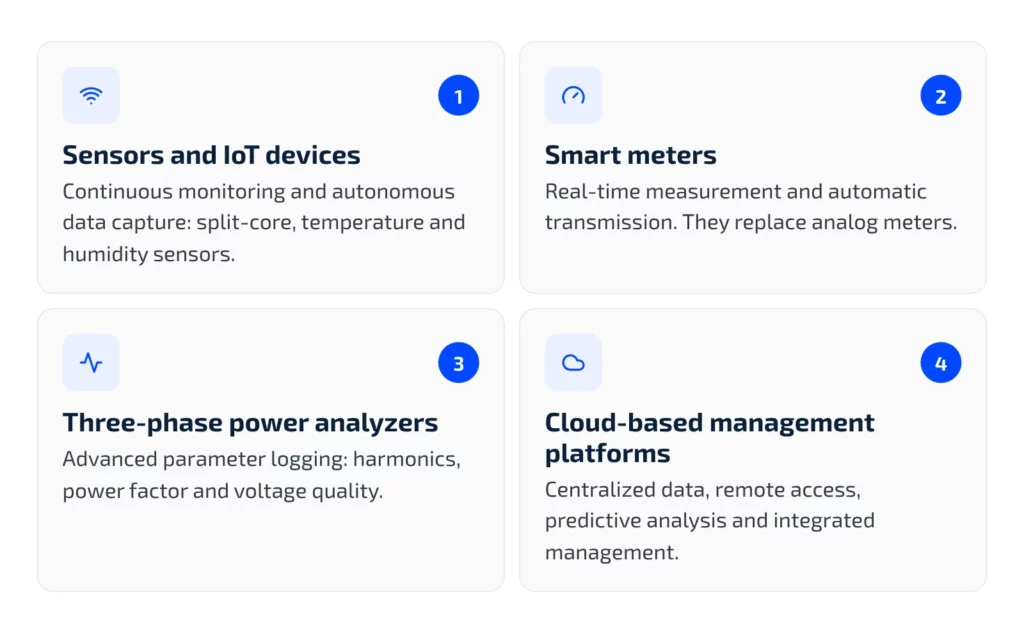
To help you understand it better, the system follows these steps so that the data stops being numbers and becomes solutions for you:
IoT sensors and devices
IoT sensors are the eyes of your system. They allow constant monitoring through connected devices that autonomously capture data. There are, for example, split-core current sensors (clamps) that you can install without having to cut off the electricity, as well as temperature, humidity and air quality sensors.
Smart meters
They are the evolution of your classic meter. Digital devices that measure in real time and transmit the data automatically to the platform. A great advantage for you is that they allow you to reconvert old analogue meters using IoT sensors, so you won’t always need to change the entire existing infrastructure.
Power quality analyzers (three-phase)
They are more specialized equipment that records advanced electrical parameters of your network, such as harmonics, power factor or voltage quality. They are fundamental technical indicators if you want to optimize your energy performance to the maximum.
Cloud management platforms
It is the software that transforms data into solutions. Centralizes information from multiple facilities, allows remote access from any device, generates predictive analysis and provides integrated energy management.
What data does an energy monitoring system offer you
Advanced systems don’t just tell you “how much you’ve spent,” they provide you with accurate information on multiple variables:
- Total and disaggregated energy consumption: You can see your global data or go down to detail by specific areas, circuits, equipment or processes.
- Power demand: Identify your peaks and valleys of consumption at all times, which is key for you to adjust the contracted power.
- Technical electrical parameters: Current, voltage, power factor and reactive energy of your network.
- Temporal comparisons: Allows you to compare work shifts, days, weeks, months or seasons of the year so you can see trends.
- Efficiency indicators (KPI): Customized metrics depending on what your company does.
- CO₂ emissions: The environmental impact associated with your energy consumption.
- Environmental variables: Temperature, humidity and outdoor climate data, which directly affect your consumption (especially in air conditioning).
- Projected energy costs: Simulations of how much your bill will be before you receive it.
From energy monitoring to energy management
It is important to make a nuance: although energy monitoring is essential, it only represents your first step. Monitoring is limited to collecting, measuring and visualizing data. Energy management goes further: it involves defining objectives, implementing improvements, establishing baselines, looking for savings opportunities and evaluating your efficiency continuously.
In addition, the data collected through monitoring can be used to obtain energy savings certificates (CAEs), monetizing the improvements implemented and accelerating the return on investment.
On the other hand, the most advanced systems integrate monitoring within Energy Management and Optimization Systems (EMOS) based on international regulations such as ISO 50001, which facilitate the planning, control and continuous improvement of your company’s entire energy strategy.
Energy monitoring as your first step toward savings
Monitoring is the basis of everything. If you want to reduce costs, you first need to know where and how you use energy. However, to maximize its potential, your company needs to evolve toward energy management and optimization platforms (EMOS) that integrate hardware, software and intelligent automation into a comprehensive solution.
EMOS platforms such as OTEA allow you not only to monitor, but also to optimize and automate installations, manage multiple sites centrally and remotely, simulate electricity bills, make predictions based on Artificial Intelligence and detect breakdowns quickly. This integration capability ensures that the platform evolves with your business needs without requiring constant solution changes.
In the end, everything is connected. Understanding energy efficiency allows you to read the data, but the key is to combine it: while the energy certificate is a still photo of your building, monitoring is real-time video of what happens inside.
In addition, monitoring integrates perfectly with building automation and proactive installations strategies, allowing your systems to adjust only based on the data. The combination with IoT for energy management and the performance of energy audits complete a technological circle that transforms simple measurement into real savings and operational sustainability for you.

Recommended for you

You deserve a facility management system that works with you
Request a free demo and discover how other maintenance, sustainability, and energy efficiency teams are achieving real results. No unnecessary complexity. Just a clear roadmap designed to scale with you.




