
Indicators and systems for measuring energy efficiency in a smart building

We have always seen buildings as simple shelters, but that idea has become obsolete. Today, buildings have evolved into infrastructure that self-regulate to function optimally. We call them “smart buildings,” and they have changed the rules of the game in how we manage energy. Knowing in detail how much energy is spent in each corner not only opens our eyes to possible savings, but also becomes the basis for making decisions that impact costs, comfort and compliance with environmental regulations.
To give us an idea of the impact: a building with advanced monitoring systems can reduce its energy consumption between 25 and 30%. If we add automation technologies to that, savings in operation and maintenance costs can increase another 20 or 40%. This ability to measure energy efficiency in real time and act accordingly allows us to make a qualitative leap: we stop putting out fires and solving problems when it is too late (classic reactive management) and start having predictive strategies that anticipate needs and optimize resources automatically.
And how exactly is energy efficiency measured in a smart building?
Measuring efficiency in a smart building is a well-coordinated combination of several technologies working together. On the one hand, we have the “hardware”: a network of IoT sensors spread throughout the building that act as its nervous system, capturing data of all kinds.
On the other hand, the “software”: energy management systems and predictive analysis algorithms that work like the brain, processing all that information. Together, they create a truly comprehensive monitoring environment that allows us to collect data from different sources and, most importantly, turn it into real solutions that optimize performance.
The factors that most influence consumption: the pieces of the puzzle
To understand how to optimize a building, you first have to know where energy is used. There are several fronts that determine its efficiency, covering both technical aspects of its construction and the way in which it is used on a daily basis.
- Thermal envelope and insulation: The first front, and perhaps the most fundamental, is what is known as the building envelope. Imagine that the building is a person on a cold day. The envelope is its shelter. The quality of its insulation, air tightness (that is, no unwanted drafts), and the quality of the windows are crucial.
A bad envelope is like a coat full of holes. Weak points, such as thermal bridges (areas where the insulation is interrupted, such as in pillars or window frames), are true energy sinks through which heat escapes in winter and enters in summer. A building with a well-designed envelope can require up to 40% less energy. - Smart HVAC systems: Then there is the heart of comfort, air conditioning (HVAC). Traditional systems work with a simple thermostat that is inefficient and abrupt: when it is cold it turns on to maximum and when it reaches the temperature, it turns off.
Modern systems with predictive control are another story. They use occupancy information, weather forecasts for the next few hours and even learn from the patterns and thermal inertia of the building itself (how long it takes to heat up or cool down) to operate smoothly and progressively, anticipating. These systems can generate savings of 20-30% compared to traditional devices. - Adaptive lighting management: Something very similar happens with lighting. The era of rows of always-on fluorescent lights is over. Connected LED systems, using occupancy and daylight sensors, are the norm in efficient buildings. An empty meeting room doesn’t need light. An office next to a large window on a sunny day can reduce its artificial light to a minimum.
This “daylight harvesting” not only saves energy, with reductions of up to 60%, but improves people’s well-being by synchronizing with natural circadian rhythms. - Occupancy patterns: Also, something that is often underestimated is the building usage patterns. An office building is not used the same on a Monday at 11 in the morning as it is on a Saturday at 8 in the afternoon.
Knowing how many people there are at each time and place thanks to different sensor technologies (from the classic infrared PIR, to microwaves or image analysis) allows the systems to adjust to real use, avoiding wasting a huge amount of energy in air conditioning and ventilating areas that are completely empty. - Data quality from IoT sensors and Integration with renewable energies: Of course, all this works thanks to the quality of the data from IoT sensors, which monitor all parameters in real time (temperature, occupancy, energy consumption, air quality…) and provide the precise information on which all the optimization algorithms are built.
Without reliable, well-integrated data, even the best energy management systems make incorrect decisions. - Self-consumption and energy storage: Finally, the ability to generate renewable energy locally through photovoltaic panels and store it in batteries (BESS systems) is transforming the efficiency of smart buildings. These systems allow solar energy to be used when it is really needed, not just when it is generated, and reduce dependence on the electrical grid.
Smart energy managers automatically optimize when to use stored energy, when to buy it from the grid when it is cheap and when to sell surpluses, achieving cost reductions of up to 30%. In some cases, buildings can become positive energy buildings that generate more than they consume.
The indicators that tell us if we are doing well (KPIs)

To manage something, you must first measure it. And to measure it well, we need objective and standardized metrics. These indicators, or KPIs (Key Performance Indicators), give us a clear picture of the building’s performance and, very importantly, allow us to do energy benchmarking: that is, a comparative analysis with other buildings with similar characteriztics to know if we are on the right track.
Energy use intensity (EUI)
This is, without a doubt, the star indicator, the building’s energy identity card. So that we understand each other, measures how much total energy is consumed per year per square meter (kWh/m²/year). It is the main measuring stick to compare similar buildings, since it normalizes consumption per surface. A reference building can be around 100-300 kWh/m²/year, while a high-efficiency building moves below 50 kWh/m²/year.
Efficiency of air conditioning systems (HVAC)
Here we evaluate equipment performance with metrics such as coefficient of performance (COP) for heating and seasonal energy efficiency ratio (SEER) for cooling. They tell us how much air conditioning we get for each watt consumed. Intelligent systems can improve these ratios by 25 to 35%.
Energy load factor
It measures the relationship between the energy that we actually consume and the maximum capacity that we have contracted or installed. A factor above 70% tells us that we are making good use of the energy infrastructure, while a very low factor may indicate oversizing.
Indoor Air Quality Index (IAQ)
It’s not all about spending less. An efficient building must also be healthy. This index measures parameters such as CO₂ levels (an indicator of how “charged” the environment is), volatile organic compounds (VOCs), humidity and temperature. Optimal CO₂ levels (400-1000 ppm) indicate efficient but waste-free ventilation.
Setpoint compliance rate
This is an indicator of the reliability of the control system. Basically, it measures the percentage of time that the systems manage to maintain environmental conditions (temperature, humidity) within the ranges that we have asked of them. A high rate means that the control system is precise and responsive.
Systems and tools to measure energy efficiency
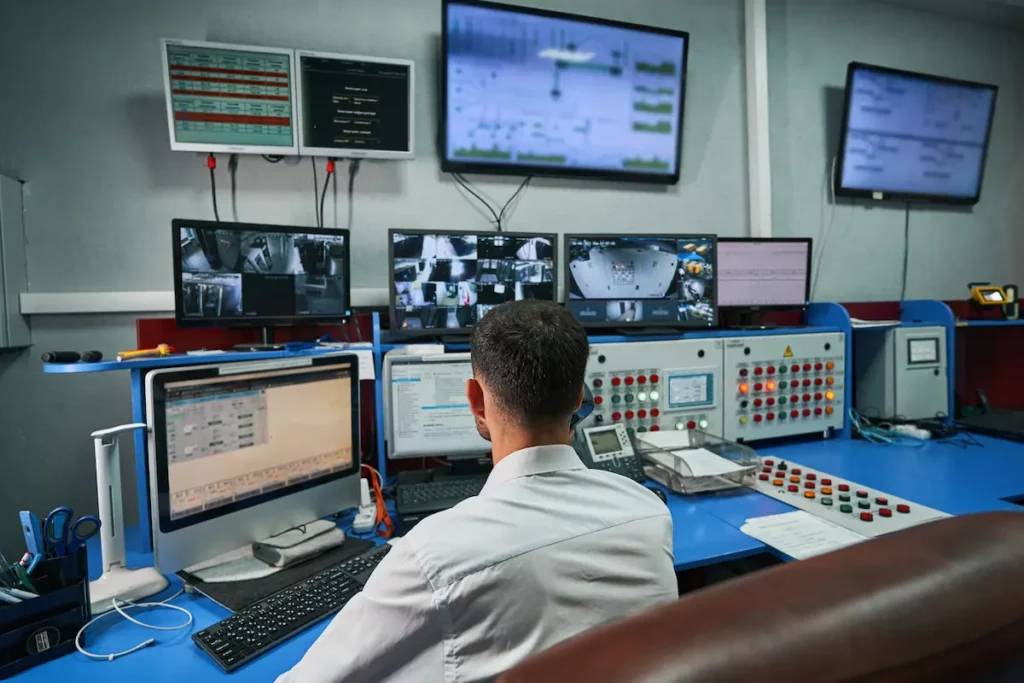
Very well, we now have clear indicators that tell us if a building is efficient. The next question is logical: how do we get all that data and put it to work? This is where technology comes into play. We are not talking about a single tool, but about a true technological ecosystem where each piece fulfills an essential function to obtain that complete vision of the building. These are the most important ones:
Monitoring and control platforms
The energy management platforms, such as OTEA’s EMS, are the center of operations. Imagine a control panel where you can see in real time and in a very visual way everything that is happening in your building. They centralize all the data obtained and present it in easy-to-understand graphs, which helps enormously in the analysis of electricity consumption.
Imagine receiving an alert on your cell phone because the consumption of a plant has skyrocketed at night for no reason. Being in the cloud, you can access it from anywhere and compare different facilities, which is very useful for companies with multiple buildings.
Connected smart sensors and meters
They are the eyes and ears of the building. From energy meters that monitor consumption with an accuracy of over 99%, to environmental sensors or occupancy detectors that allow systems to be adjusted to real use.
Predictive models and digital twins
This is where things get really interesting. Machine learning analyzes all that historical data to find patterns and predict what is going to happen. This is the basis of predictive maintenance, which can predict failures in air conditioning equipment with an accuracy of more than 85%, allowing it to be repaired before the breakdown occurs.
The evolution of this is the “digital twin”: a virtual and exact replica of the building that is fed with data in real time. In this digital twin you can simulate changes (“what if we raise the temperature one degree?”, “what if we change these lights for others?”) and see their energy impact without having to touch anything in the real building. It is a safe testing ground for optimization.
Global management with energy software
This software integrates all the information and automates decisions, such as adjusting the air conditioning according to electricity rates or generating reports for energy saving certificates.
With all this data, where do we start to improve?
Continuous measurement allows us to see opportunities for improvement that were previously completely invisible. A traditional analysis gives you a still photo, but real-time monitoring is like having a continuous video that reveals patterns and waste. For someone who wants to improve energy efficiency thanks to measurement, the path could be as follows:
- Audit and initial diagnosis: The first step is to know where you are starting from. A good energy audit and the installation of basic monitoring will give you the initial map of your consumption.
- Identify easy wins: With the first data, you will immediately see obvious optimizations. You may find that the air conditioning stays on all weekend. Adjusting operating schedules to actual use can reduce consumption by up to 35% with almost no investment.
- Implement automatic control: The next step is to let the system make simple decisions, using data from the sensors so that the lights and air conditioning regulate themselves.
- Advanced optimization: This is where Model Predictive Control (MPC) algorithms come into play, which use predictions to anticipate and make the best possible decisions, reducing consumption by up to an additional 18%.
And this is where energy management platforms (EMS) play a fundamental role. They unify all the information and allow each step to be executed, from diagnosis and simple savings to automatic control and optimization. All this is structured through the BACS systems (Building Automation and Control Systems), the brain that coordinates everything so that it works as a team. Its implementation generates savings of 10 to 25% and is key to complying with regulations such as UNE 52120.
The regulations and standards that mark the way

All this effort is not done in a vacuum. There is an increasingly strict legal framework and standards that push us in this direction. In Europe, the Directive Energy Efficiency of Buildings (EPBD) 2024/1275 is the one that sets the roadmap with very ambitious objectives that you should know:
Building automation: Since December 2024, non-residential buildings with heating or cooling capacity greater than 290 kW must have centralized automation: temperature and CO₂ sensors, programmable schedules, alarms for abnormal consumption and data logging. More phases follow: air quality measurement (May 2026), automatic lighting controls (December 2027) and stricter requirements for smaller buildings (December 2029).
The most important thing: Technology alone saves nothing. Systems must be connected to each other (without proprietary “islands”) and share data openly. Without this, automation is just decoration.
Reduction objectives: Less efficient buildings must be renovated (16% by 2030, 26% by 2033 in non-residential). The ultimate goal is for 2050 to have zero emissions.
In addition to the EPBD, there are other important standards such as ISO 50002-1:2025 for energy audits, and prestigious certifications such as the LEED certification v4. Achieving one of these certifications can increase the rental value of a building by up to 20% because tenants increasingly value sustainable spaces. There is also the Smart Readiness Indicator (SRI), which measures how “smart” a building is. A low SRI will be a red flag for buyers and renters.
Toward truly intelligent energy management
In the end, after looking at all these elements, the conclusion is clear. We are in full transition. It is no longer enough to build four walls and a roof. Energy management is no longer an inevitable expense but has become a competitive advantage. The future involves almost autonomous buildings in their energy optimization, thanks to the convergence of IoT, artificial intelligence and predictive analysis.
Operational and energy efficiency platforms such as OTEA are the tools that make this transition possible. They not only measure, but they act, and they also make life easier by automatically documenting savings to, for example take advantage of CAEs incentives. In short, advanced measurement is the cornerstone of 21st century buildings. Buildings that not only consume less energy, but are more comfortable, healthier for their occupants and actively contribute to the stability of the electrical grid. We are no longer just talking about saving money or complying with a rule. We are talking about a strategic investment that returns economic, environmental and well-being benefits, preparing our buildings for a future that is already here, a smarter and, above all, more sustainable energy future.

Recommended for you


You deserve a facility management system that works with you
Request a free demo and discover how other maintenance, sustainability, and energy efficiency teams are achieving real results. No unnecessary complexity. Just a clear roadmap designed to scale with you.




