
How to move from basic energy monitoring to advanced optimization
Many companies already have monitoring systems, consumption history and monitoring tables, but they still have the same difficulty: converting this data into concrete improvements in the operation and costs of the installation.
Moving from basic monitoring to more advanced optimization is not just about measuring more. It consists of having a reliable database, analysis capacity, control rules and tools to act on the installation with defined criteria.
On this journey, OTEA, the EMOS platform developed by EcoMT, connects monitoring, remote control and optimization to convert real-time energy data into operational decisions about the installation.
What does it mean to monitor energy?
Energy monitoring consists of measuring and visualizing what an installation consumes. This includes variables such as kWh, power, load curves, comparisons between periods or simple alarms, normally based on meters, submetering and a platform that centralizes the information.
An energy monitoring system in companies provides visibility over consumption and helps detect basic patterns. The limit appears when this information does not translate into changes in schedules, instructions, assets or priorities for action.
That is why it is worth differentiating the two steps. Monitor allows you to know what is happening; managing involves using that information to decide and correct how the facility is operated.
Limits of basic monitoring
Many facilities have data, but have not managed to ensure that this data has a clear impact on the operation. This usually happens for several reasons:
- A lot of information and little prioritization capacity. Consumption and deviations are detected, but it is not always clear what to do first.
- Manual interpretation. If everything depends on periodically reviewing graphs, many incidents are detected late.
- Lack of operational context. A consumption peak may respond to an anomaly or normal use of the installation; Without more variables, it is difficult to interpret it correctly.
- Lack of control. An incident is identified, but there is not always the capacity to act on the equipment or automate the response.
- Multi-site complexity. When each center works with different criteria, comparing behaviors and replicating improvements is more difficult.
Monitoring provides visibility, but it does not by itself resolve how the facility is operated. To move forward, operating rules, control capacity and a clear way to translate data into concrete actions are needed.
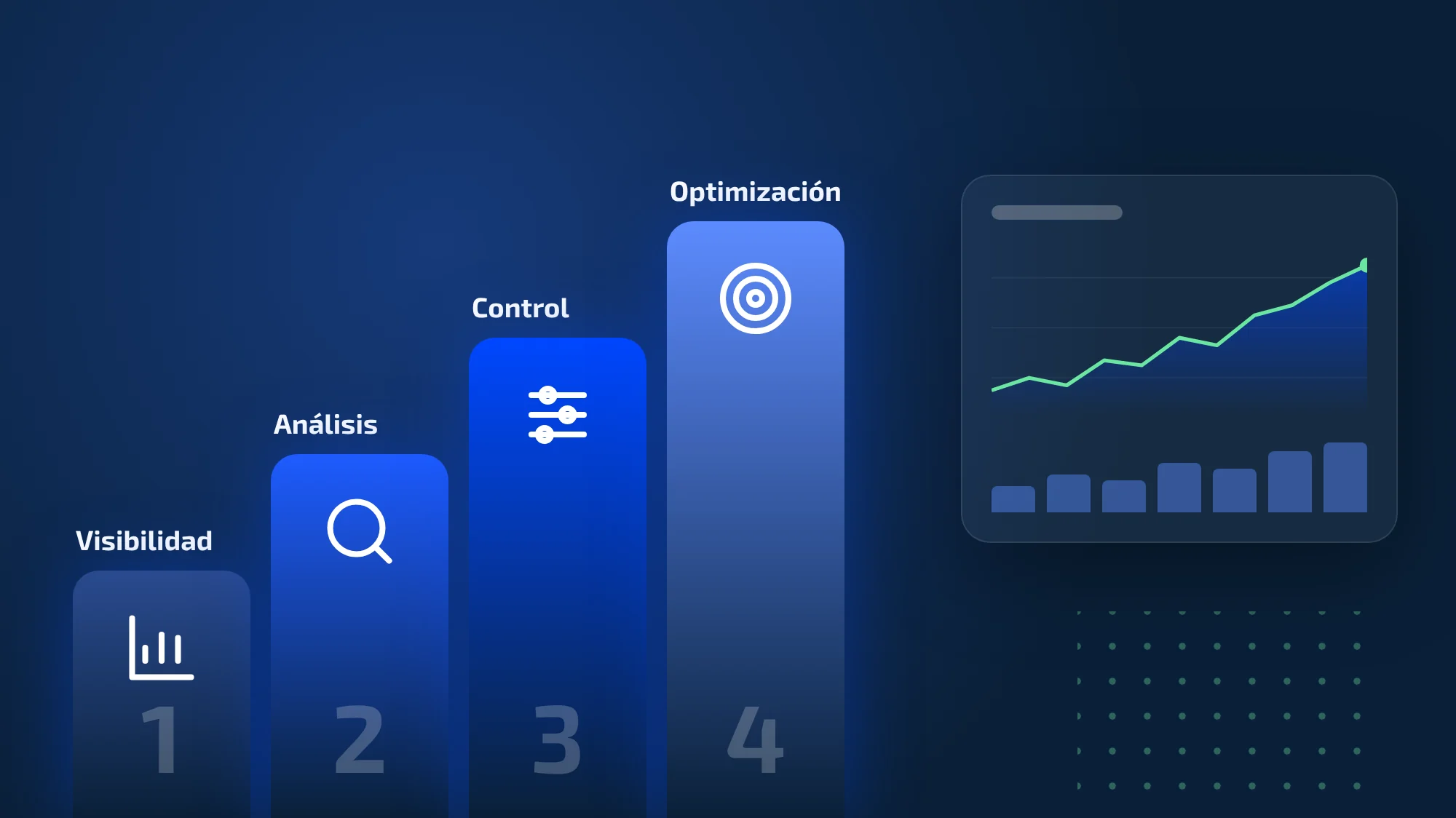
The levels of maturity in energy management
A useful way to understand this evolution is to think about maturity levels. It is not about incorporating technology without criteria, but rather gaining the ability to detect earlier, decide better and operate with more control.
Level 1: Basic monitoring
- What it allows: visualize consumption, power, comparisons between periods, simple alarms and reports.
- What has not yet been resolved: Many deviations continue to require manual review, it is difficult to anticipate and it is difficult to maintain homogeneous criteria in several sites.
- What is needed to move forward: Improve data quality, measure where it really matters, and add operational context to analyze, not just visualize.
Level 2: Analysis and detection of anomalies
- What it allows: to detect out-of-pattern consumption, identify equipment or areas active outside of hours and better separate base consumption and variable consumption.
- What it hasn’t solved yet: If everything depends on human intervention, it is difficult to correct systematically and prevent the problem from recurring.
- What is needed to move forward: integrate control capacity over equipment and define clear operating rules.
Level 3: Automation and control
- What it allows: Apply remote control rules, adjust setpoints by time and zone, activate actions when certain conditions are met and better organize the operation in several centers.
- What it does not solve yet: If everything is based on static rules, the facility has less capacity to adapt to changes in occupancy, climate or production.
- What is needed to move forward: Having reliable records, behavioral references and an optimization layer that allows adjustments to be recommended or executed depending on the project.
Level 4: Predictive Optimization
- What it allows: anticipate demand, adjust strategies before deviations appear and prioritize actions according to operational or energy impact. At this level, advanced energy management is reflected more clearly in the daily operation of the facility.
- What it requires to be sustained: data quality, available integrations, well-defined rules and clear governance on who decides, who validates and what degree of automation is applied.
What does it mean to make the leap to advanced optimization?
Taking this step is not just about incorporating a new tool. It means going from reviewing consumption to operating the installation with more criteria, relying on historical data, real-time signals and rules of action.
When that transition is done correctly, an organization can:
- Detect deviations and abnormal consumption earlier.
- Make decisions with more judgment, because you know where to act first.
- Improve coordination in multisite environments.
- Maintain improvements over time by connecting analysis, control and monitoring.
At this point, an EMOS platform provides much more than a system focused only on visualization. An EMOS like OTEA helps convert historical and real-time signals into actions, rules and operational monitoring.
What technology makes this leap possible?
The evolution from basic monitoring to more advanced optimization is usually supported by several technological layers that complement each other.
- IoT and sensors, to capture variables that provide context, such as temperatures, states, occupancy or CO₂.
- BMS, to control and supervise installations such as air conditioning or lighting.
- Dataloggers, when it is necessary to collect data from meters or equipment without integrated communications.
- EMOS, as a layer that unites data, operation and optimization, and connects monitoring with decisions and control actions.
The key is not to incorporate everything from the beginning, but to organize the route well: measure where it matters, interpret better and add control and optimization when the base is already sufficient.
Signs that your installation is ready to optimize
There are several signs that usually indicate that an installation already has a basis to take the next step:
- There is already data and consumption curves, but it is not clear which levers to move first.
- Problems such as peaks, equipment out of hours or high base consumption are detected late.
- There are many manual settings and each technician applies their own criteria.
- The organization manages several sites and it is difficult to compare behaviors or replicate improvements.
If you are also evaluating a energy audit, it is usually a sign of maturity: you are no longer looking to just diagnose, but to convert that diagnosis into an action and monitoring plan.
Where to start?
To go from theory to practice, the route can be outlined like this:
- Clarify the objective. Define whether the priority is to reduce base consumption, detect anomalies, organize the operation or improve multisite management.
- Start with a specific use case. It is preferable to validate useful logic first than to deploy too many functions at once.
- Ensure data quality where it matters. It is not necessary to measure everything, but it is necessary to measure well what has a real impact on the installation or the invoice.
- Connect analysis with action. Start with simple rules and then evolve to more advanced logic.
- Scaling what works. If a way of operating works in one facility, the next step is to standardize it and bring it to the rest.
If you want to accelerate this leap, it is usually useful to combine a diagnostic phase with the deployment of OTEA, the EMOS platform developed by EcoMT, capable of monitoring, analyzing, controlling and optimizing according to the scope of the project and the governance of each organization. Monitoring is necessary, but it only adds value when it is translated into decisions and actions on the installation.

Recommended for you


You deserve a facility management system that works with you
Request a free demo and discover how other maintenance, sustainability, and energy efficiency teams are achieving real results. No unnecessary complexity. Just a clear roadmap designed to scale with you.




