
Energy performance certificates for businesses and how to obtain them
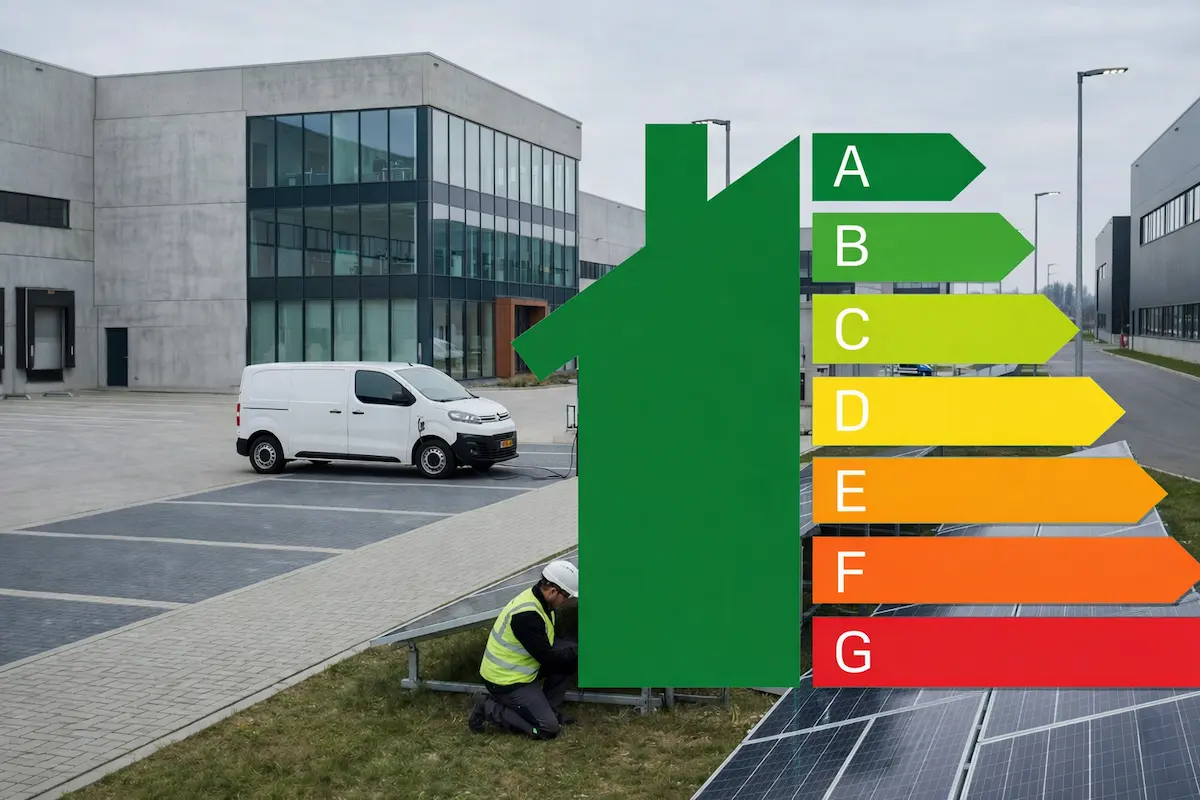
If your company intends to sell or rent a commercial premises, an office or any other property, you have probably heard of the energy performance certificate. But do you really know what it is and why it is so important? It is not just a mandatory administrative procedure, but a document that shows you exactly how your building behaves from an energy point of view. It is, in a way, the x-ray of how you are using energy.
Understanding this certificate well is essential if you want to go beyond complying with the law and truly optimize your energy consumption. And that is what we are going to explore next.
What is the energy performance certificate?
First of all, the energy performance certificate is an official document that assesses two pieces of information: how much energy your building uses and how many CO₂ emissions it generates. It is regulated by Royal Decree 390/2021, so it has all the legal weight behind it. What it does is give you clear and objective information about the energy characteriztics of your property, information that can be used by everyone from the owner to someone who is thinking about buying or renting it.
The certificate is not a piece of paper empty of data. It includes information on the identification of the building, what its thermal envelope is like (this is important: facades, roofs, glass enclosures…), what air conditioning and lighting facilities it has, and a classification that goes from A to G. In addition, it tells you the consumption in kWh/m² per year and the CO₂ emissions in kg/m² per year.
When is the energy performance certificate mandatory in companies
Here is something that surprises many: since June 2013 it is mandatory to have this certificate if you are going to sell or rent any building, office or commercial premises. It is not a recommendation, it is the law. And that also applies to new buildings: you have to have it before finishing the work.
If your company has more than 250 employees or has a turnover of more than 50 million euros, the regulations become a little more complicated. In addition to the certificate, you are obliged to do an energy audit every four years. And if it is a public building of more than 250 square meters and frequently used, the efficiency label must be visible.
Obviously, there are exceptions. For example, historically protected buildings, temporary constructions that last less than two years, or detached single-family homes of less than 50 m². But if your property does not fall into those exceptions, you do need the certificate.
What information and data are taken into account to issue the certificate
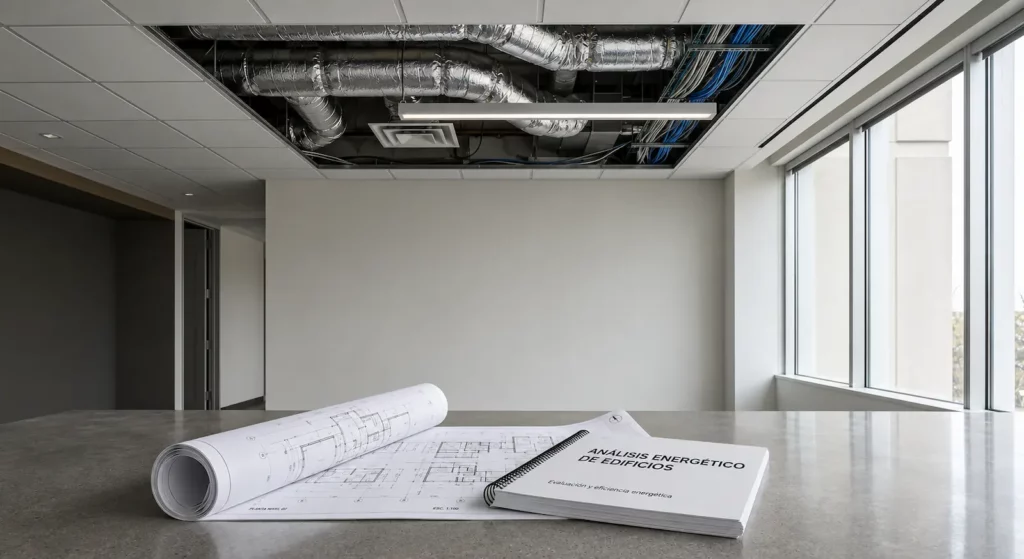
To certify your building, the technician needs to collect several pieces of information during the visit:
- Identification data: full address, cadastral reference and climatic zone of your building.
- Characteriztics of the thermal envelope: measurement of facades, roofs, basements, openings and skylights, including construction materials and insulation.
- Thermal installations: heating, cooling, domestic hot water systems, with a description of power and consumption.
- Lighting: especially relevant if you have commercial premises and tertiary buildings.
- Solar orientation and thermal bridges: elements that significantly affect energy behavior
- Age and type of construction: information on the year of construction and the energy regulations applied
The technician also assesses the type of window and door frames, installed glass, ventilation systems and any supporting documentation that you have available such as boiler inspection certificates or quality reports.
Who can issue the energy performance certificate?
Only technicians who are authorized according to Royal Decree 390/2021 have permission. But who counts as an authorized technician? Basically, someone with a qualification that allows them to carry out building projects, direct construction or, in this case, sign energy performance certificates.
This opens the door to architects, surveyors, engineers of different specialties (industrial, civil, telecommunications, agronomists). What matters is that they have the necessary training to correctly evaluate the energy efficiency of your building.
A recommendation: if you are looking for someone, check their credentials. Each autonomous community maintains a public registry of authorized technicians, so you can verify that everything is in order.
How to obtain the energy performance certificate in business environments
The process to obtain the energy performance certificate for commercial premises and business buildings follows the following steps:
- Hire an authorized certification technician: The normal thing is to look for one through professional associations or specialized directories. Make some calls, compare quotes.
- Perform on-site inspection: The technician goes to the building, measures, takes photos, collects data on facilities. This is the part that takes the most time.
- Prepare the certificate: The professional enters all the information into official recognized computer programs (type CE3X or HULC). These software simulate and calculate the energy consumption of the building with the data provided. Here are the numbers that define your energy rating.
- Register the certificate: You must present it to the administration of your autonomous community, normally online. Sometimes there is a fee to pay, sometimes not, it depends on where you live.
- Obtain the energy label: Once the administration reviews it, they give you the official label that visually summarizes the rating obtained.
Important information: The deadline to register varies depending on your autonomous community. In the absence of a specific deadline, one month from its issuance applies, although many communities process it in less than 48 hours. Additionally, the certificate is valid for ten years, although if you make serious efficiency improvements, you can renew it sooner.
What the energy rating and energy efficiency label mean
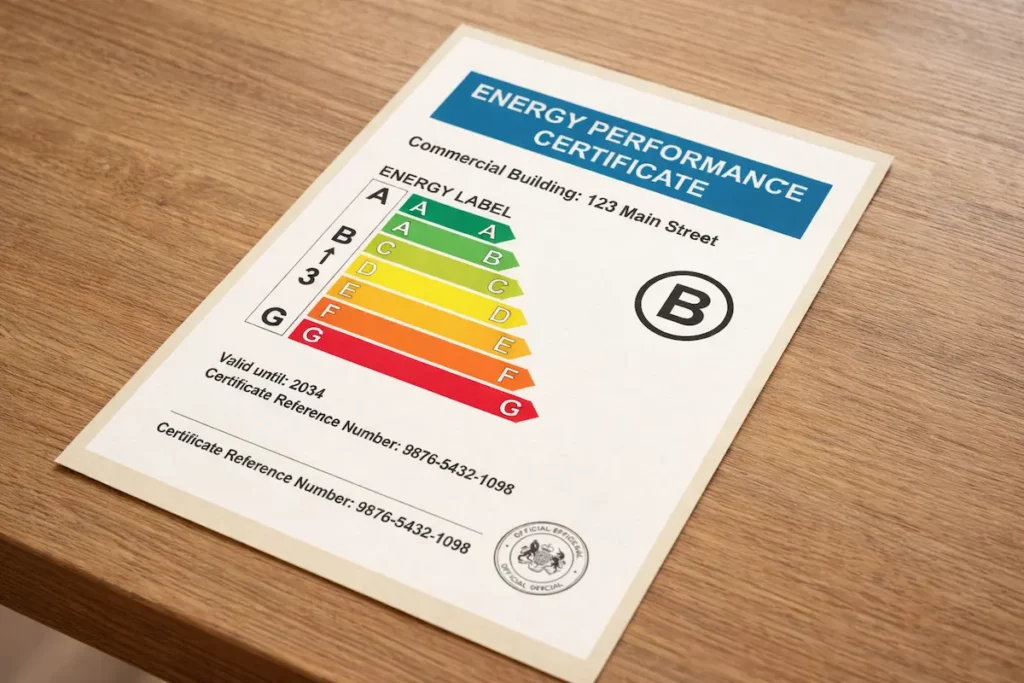
The grade is a letter: it ranges from A (very efficient) to G (not very efficient). This classification is based on both the estimated energy consumption and the CO₂ emissions generated. Important: the numerical thresholds of each letter vary depending on the climatic zone and the type of use of the property (residential, commercial, etc.), so there is no single “A” value applicable to all buildings.
The label you see is visual: colors that range from green to red, which allows you to quickly compare different properties without having to enter numbers. It is simple and effective.
Limitations of the energy performance certificate
This is where you have to be honest: the certificate has its limitations. And it is important that you understand them.
The certificate is a still photo of your building at a specific time, based on standardized conditions of use. The problem is that reality is much more dynamic. Your actual consumption depends on whether there are people working in the building, how many hours you use it, what the winter is like that year, whether someone left the lights on out of habit.
The certificate does not tell you any of that, since it does not carry out continuous energy monitoring. Nor do you see the day-to-day inefficiencies, those consumption peaks that suddenly appear, that deviation between what theory predicts and what happens in reality. It’s like having a photo from six months ago: useful, but not to know how you are right now.
The energy performance certificate within the building’s energy management
The certificate cannot be the end of the road. If you’re serious about sustainability and lowering your energy bills, you need to think of it as a starting point.
From certification to continuous improvement of energy performance
The logical thing is that after having it, you act based on what it says. Implement the improvements they recommend. But not only that. You need a system that allows you to continually measure how you are doing, set clear goals, invest in what works, and then verify that consumption is really decreasing.
To do this correctly, you need to know what exactly energy efficiency is, because the certificate makes more sense if you understand well what you are measuring. And then, you’ll probably be interested in doing a energy audit that goes deeper into where exactly you are spending money unnecessarily on your installation.
The role of energy monitoring and management in business buildings
As we told you, the certificate only gives you a static photo, while the energy monitoring gives you a “video” in real time. With connected sensors and meters, you constantly know how you are using energy.
When you use monitoring systems, you can centralize all the information about your facilities, detect what is not working well, anticipate problems before they become breakdowns, and automatically adjust how your equipment works. Through proactive building automation and installations, you turn that data into decisions that truly save money.
But there is more. You can connect your certification with the real savings you achieve, seeing how the changes you make translate into numbers. And if you are looking for something even more comprehensive, the LEED certification goes far beyond energy consumption, looking at the comprehensive sustainability and well-being of those who work in the building.
The truth is that when you combine the certificate with continuous monitoring systems and energy management systems like those offered by OTEA, you go from simply complying with the law to truly optimizing your building.

Recommended for you


You deserve a facility management system that works with you
Request a free demo and discover how other maintenance, sustainability, and energy efficiency teams are achieving real results. No unnecessary complexity. Just a clear roadmap designed to scale with you.




