
Corrective, Preventive and Predictive Maintenance: What They Are and When to Use Each in Your Facilities

In most companies, maintenance is still managed on a fairly simple basis: “when something breaks, we call a technician.” It’s the best-known approach, but also the one that causes the most disruption, hidden costs and lost efficiency.
The good news is that you have more options today. There’s no single right or wrong choice between corrective, preventive and predictive maintenance: some maintenance strategies fit better than others depending on the type of facility, how critical the equipment is, and how far along you are digitally. In this article, we’ll look at what maintenance types exist in facility management, what each one involves, and how to combine preventive, predictive and corrective maintenance by drawing on monitoring, facility maintenance and platforms like OTEA.
What maintenance types exist in facility management?
When we talk about maintenance types in buildings or industrial environments, three main models usually come to mind: corrective, preventive and predictive.
From there, other terms come up, such as reactive maintenance, condition-based maintenance or data-driven industrial maintenance strategies, but the underlying question is always the same: do you act after the failure, before the failure on a fixed schedule, or before the failure based on real operating data?
In practice, no facility runs on a single maintenance type alone. The usual approach is to combine them based on how important each piece of equipment is, the cost of downtime, and how digitalized your facilities are.
Corrective maintenance
Corrective maintenance, the traditional approach, is based on stepping in only once a breakdown occurs. It’s simple to manage, and for non-critical equipment it can look like the cheapest option.
When is corrective maintenance applied?
Corrective maintenance comes into play once the equipment has already broken down and you need to bring it back to normal operation. In other words, it’s reactive by definition: you wait for the failure and act afterward.
It makes sense for equipment that isn’t critical to operations and is low-cost, easy to replace and with spare parts readily available, where a one-off incident doesn’t compromise the core operation. On the other hand, it becomes very expensive when it affects critical installations such as central HVAC, cold storage rooms, electrical panels or pumps. That’s where preventive and predictive maintenance, backed by intelligent facility control through EMOS systems like OTEA, start to make a real difference.
Advantages and disadvantages of corrective maintenance
Its big advantage is how simple it is to manage and its low upfront cost: you don’t need to plan ahead or invest in monitoring to get it running. In exchange, you take on more unplanned downtime, hidden costs, and a poor fit with energy efficiency and decarbonization targets as the volume of breakdowns grows, which is why it’s usually reserved for a limited group of non-critical equipment.
Preventive maintenance
Preventive maintenance takes things a step further. Instead of waiting for a failure, you schedule periodic inspections and interventions based on time in use, operating hours or manufacturer recommendations. Replacing filters every six months or carrying out an annual boiler inspection are common examples of this maintenance type in buildings and industry.
How does preventive maintenance work?
In practice, preventive maintenance relies on calendars and maintenance plans that define which tasks are carried out and how often, whether based on time, service hours, or manufacturer and regulatory guidelines. This model is typically managed through a CMMS (Computerized Maintenance Management System), a tool that centralizes work orders, schedules interventions and keeps a history for each asset. This fits well with many industrial and building maintenance types where there are safety requirements or mandatory regulatory inspections.
Advantages and disadvantages of preventive maintenance
Preventive maintenance reduces unexpected breakdowns, improves facility safety and makes regulatory compliance easier, because you know in advance when and how an intervention will take place.
But it also has a downside: the risk of “over-maintenance.” You can end up replacing parts that still have useful life left, or bringing forward inspections simply because the calendar says it’s time, resulting in more labor hours, spare parts and scheduled downtime than actually necessary. Having data from a platform like OTEA helps fine-tune those frequencies and move closer to condition-based maintenance, where the calendar stops being the only criterion.
Predictive maintenance
Predictive maintenance goes a step further than preventive maintenance. Rather than relying solely on dates, it draws on real operating data to anticipate when a failure is likely to occur and to act just before it happens.
What is predictive maintenance based on?
In practice, it combines three elements: sensors that monitor specific variables depending on the type of equipment (differential pressure in filters, flow rate in pumps, temperature in cold storage rooms, vibration in motors, or abnormal electrical consumption); platforms that collect this data in real time and detect anomalous patterns; and algorithms that estimate the equipment’s condition and trigger alerts when the risk of failure increases. This way, you no longer inspect a piece of equipment every six months “because it’s due,” but because it starts to deviate from its normal behavior.
Advantages and disadvantages of predictive maintenance
The main advantage of predictive maintenance is that it concentrates effort exactly where it’s needed. It reduces unplanned downtime, extends asset lifespan and improves energy efficiency, because you catch poorly tuned or over-consuming equipment earlier.
The trade-off is that it requires investment in sensors, monitoring systems and intelligent control (such as OTEA or other EMOS platforms), along with a certain level of digital maturity to interpret the data and turn it into automated maintenance decisions. If you want to go deeper into this topic, we cover it in more detail here: What is predictive maintenance and how does it work.
Differences between corrective, preventive and predictive maintenance
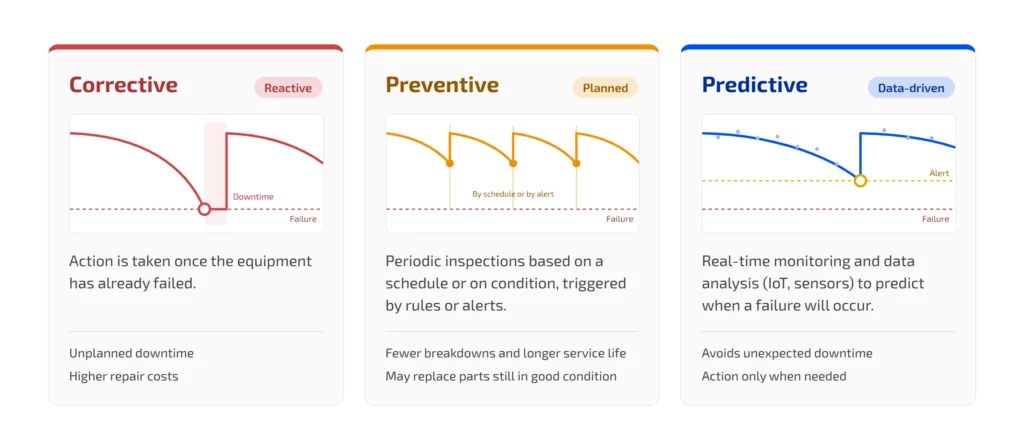
Corrective maintenance acts after the failure and is usually reserved for low-importance, low-cost equipment, accepting the risk of unplanned downtime and hidden costs.
Preventive maintenance intervenes before the failure, following a schedule or operating hours; it reduces unexpected breakdowns and improves safety, though it can lead to over-maintenance if frequencies aren’t well calibrated.
Predictive maintenance also acts before the failure, but relies on real operating data to determine the best time to intervene, concentrating resources on key equipment and optimizing costs, in exchange for greater digitalization and higher upfront investment.
Despite their differences, in the end it’s not about choosing a side, but about combining these models sensibly based on how important each piece of equipment is and the impact of its failure.
| Maintenance type | When action is taken | Basis for decisions | Typical use |
|---|---|---|---|
| Corrective | After a breakdown | Failure has already occurred | Non-critical, low-cost, easily replaceable equipment |
| Preventive | Before a breakdown, on a schedule | Time, operating hours, manufacturer recommendations | Equipment with regulatory or safety requirements |
| Predictive | Before an expected breakdown | Real operating data and equipment condition | Critical assets with economic, energy or safety implications |
Which maintenance strategy to choose depending on the type of facility
In most cases, all three models coexist. Corrective maintenance is reserved for inexpensive, easily replaceable elements; preventive maintenance is applied to equipment where the manufacturer requires periodic inspections or regulations set certain obligations; and predictive maintenance is aimed at assets whose failure would have a high impact on revenue, comfort, safety or energy consumption.
The difference between improvising as you go and actually planning lies in how you prioritize those assets and what information you use to get ahead of the problem. In environments with many pieces of equipment spread across different locations, such as retail chains, hotels or multi-site offices, having real-time data makes that step much easier.
The evolution of maintenance toward data-driven models
Today, maintenance, energy and ESG reporting are no longer managed separately. More and more organizations are integrating them into a single strategy supported by digital tools. And that’s where real-time data makes the difference. To do predictive maintenance, you need more than a calendar: you need data. Sensors that measure what truly matters, systems that collect it, and a platform capable of detecting anomalous behavior and alerting you in time.
Tools like OTEA let you monitor consumption and temperatures, automate complete processes (not just one-off responses), and intervene directly on equipment and machinery: generating alerts, opening tickets in your CMMS, adjusting temperature setpoints, or activating control rules based on occupancy or electricity tariffs.
You can also analyze trends to see how a piece of equipment’s performance evolves before it fails, and take advantage of the platform’s advanced features to act on your facilities.
This way, maintenance stops being a list of tasks in a spreadsheet and becomes a data-driven process, one where you gradually shift the balance from corrective to predictive maintenance without losing control over costs or day-to-day operations.

Recommended for you


You deserve a facility management system that works with you
Request a free demo and discover how other maintenance, sustainability, and energy efficiency teams are achieving real results. No unnecessary complexity. Just a clear roadmap designed to scale with you.




