
Methods for Measuring Energy Savings in Business Facilities

Implementing efficiency measures in business facilities is a first step: replacing lighting, adjusting schedules, optimising heating and cooling, or automating processes. The aim is to reduce energy consumption and costs, but those savings can only be verified through sound measurement.
Without a rigorous approach, it is difficult to tell whether savings come from the measures themselves or from changes in conditions such as weather, production levels or operating hours.
This article examines the most widely used energy measurement and verification (M&V) methods for estimating savings accurately, supporting investment decisions and preparing technical documentation when savings must be demonstrated, including for Spain’s Energy Savings Certificates (CAEs).
The risk of measuring savings by comparing bills
Comparing this month’s bill with the bill for the same month last year is quick, but the result combines too many external factors:
- Changes in production volume, occupancy or activity.
- Weather variations that increase or reduce demand on HVAC systems.
- Operational changes, such as new shifts or special campaigns.
- Energy price fluctuations or changes in tariff.
The result can be misleading. Lower production can make it look as if energy efficiency has improved, while a cold spell can hide a genuine improvement.
If you have already applied strategies to reduce business electricity consumption, the next step is to check their results with a more reliable method. An analysis that does not account for changes in operating conditions is incomplete.
Start by establishing an energy baseline
Before choosing a calculation method, you need to define an energy baseline. This reference describes how much energy the facility would have used before the improvement under specified operating conditions.
In standardised energy management systems, such as those following ISO 50001, the baseline provides a reference for evaluating performance over time.
How do you build an energy baseline?
An energy baseline is more than a record of past consumption. It is a model that helps answer the question: “How much energy would we have used today if the efficiency measure had not been implemented?”
To make that model reliable and repeatable, record relevant conditions alongside energy consumption:
- Electricity consumption and, where applicable, gas or other energy sources.
- Production volume or level of activity.
- Weather variables, such as degree days, when heating and cooling are significant.
- Operating hours, shifts and the working calendar.
If these data are not yet available, the first step is to implement an energy monitoring system that can collect them regularly.
Methods for measuring and verifying energy savings
Once a sound baseline is in place, several methods can be used to verify savings. They are not mutually exclusive; the right combination depends on the facility and the available data.
1. Direct meter comparison before and after an improvement
This is the most straightforward method when the effect of a specific improvement can be isolated.
- When to use it: for an individual piece of equipment or a system with separate metering (submetering).
- How it works: measure consumption before and after the intervention, adjusting for operating hours or workload.
- Limitation: if operating conditions change, a direct comparison becomes less accurate and further adjustments may be needed.
2. IPMVP an internationally recognised protocol
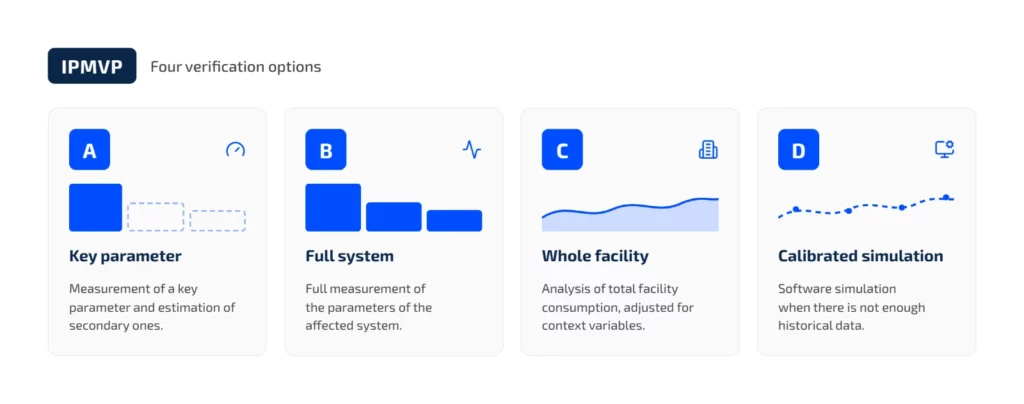
When a recognised framework is needed, for example to substantiate an investment for a third party or apply for CAEs, the International Performance Measurement and Verification Protocol (IPMVP) is a widely used reference. It sets out four verification options based on the scope of the measure and the available measurements:
- Option A: measure a key parameter and estimate secondary parameters.
- Option B: measure all relevant parameters of the affected system.
- Option C: analyse whole facility consumption, with adjustments for relevant variables.
- Option D: use calibrated software simulation when sufficient historical data are unavailable.
3. Regression analysis with variable adjustments
This method is useful when a facility’s energy consumption depends heavily on external factors such as weather or occupancy. Statistical models distinguish savings associated with the efficiency measure from changes caused by those external conditions.
- What it does: estimates expected consumption using relevant variables and compares it with actual consumption after the measure is implemented.
- What it needs: sufficiently accurate data on operating conditions. Without those variables, the adjustments become less reliable.
4. Energy benchmarking across multiple sites
For companies with several locations, energy benchmarking makes it possible to compare site performance after efficiency measures are introduced.
- How it works: define normalised KPIs, such as energy intensity, group comparable facilities and track their performance before and after the measures.
- What it reveals: which sites respond best and where operations should be reviewed or effective adjustments repeated.
A tool for comparing energy performance indicators can support this analysis by bringing together KPIs from several facilities and highlighting differences between similar sites.
How to choose the right verification method
The choice of method depends on the complexity of the facility, the purpose of the analysis and the data available:
- Isolated improvements to specific equipment: direct meter comparison or IPMVP Options A or B.
- Whole building retrofits: IPMVP Option C, with regression analysis and adjustments for relevant variables.
- Facilities without historical data: IPMVP Option D, or installation of monitoring systems to start recording consumption and operating conditions as soon as possible.
- Multiple site management: cross site benchmarking, combined with Option C for each site where more detail is needed.
If it is unclear which measures to prioritise or how to measure their impact, a professional energy audit can identify opportunities and define from the outset how savings will be verified.
The role of software in ongoing savings verification
Measuring savings once after an improvement provides only a snapshot. Facilities and their operating settings change over time, so ongoing verification helps confirm that the results last.
Energy management software provides:
- Centralised consumption data, operating variables and KPIs across one or more sites.
- Automated calculations against the energy baseline, reducing reliance on manual spreadsheets.
- Traceable data, useful for demonstrating savings to third parties or preparing CAE documentation.
In this context, it is essential to be able to create alerts and control rules for connected equipment so that deviations can be detected and addressed quickly.
OTEA, the EMOS platform developed by EcoMT, centralises energy data, allows users to configure alerts and control rules for connected equipment, and helps track savings over time. Measurement and verification thus become part of day-to-day energy management rather than a one-off exercise.

Recommended for you


You deserve a facility management system that works with you
Request a free demo and discover how other maintenance, sustainability, and energy efficiency teams are achieving real results. No unnecessary complexity. Just a clear roadmap designed to scale with you.




