
What is edge computing and why does it matter for businesses

It is often assumed that digital transformation ends when you migrate your data to the cloud. But the reality is that that is only the first step. If Cloud Computing acts as the central brain that stores and analyzes large volumes of information, Edge Computing functions as the peripheral nervous system, allowing immediate reactions.
With the explosion of the Internet of Things (IoT) and the need to make decisions in real time, the model of sending absolutely everything to a remote server is beginning to show its weaknesses. If you manage critical infrastructure or seek real efficiency, understanding this is not optional: it is the difference between a company that reacts and one that anticipates.
What is Edge Computing
Edge Computing (or edge computing) consists of bringing data processing and artificial intelligence closer to where the information is generated, whether in sensors, IoT devices, industrial machines or local systems. Instead of sending all your data to centralized data centers or the cloud, Edge Computing processes information at the “edge” of the network, allowing immediate responses and reducing latency.
This technology radically changes the rules of the game: data stops traveling hundreds or thousands of kilometers to be processed just a few meters away or even within the device itself.
A study by the consulting firm IDC reveals that global spending on Edge Computing solutions will reach almost $261 billion in 2025, with an annual growth rate of 13.8% projected until 2028.
To understand the change that adopting this technology means, imagine a smart factory with 10,000 sensors on its production line. In the traditional cloud model, each sensor constantly sends data to a remote server, waits for it to be processed, receives a response, and acts. That cycle, even with high-speed connections, introduces latency of 50-200 milliseconds that can mean faulty production or unplanned shutdowns.
Edge Computing brings intelligence closer to machines. The logic that decides what to do stays on a server inside the factory, allowing the sensors to process the data right there. This means they can react in near real time and send only those critical data needed for machine learning to the cloud.
How Edge Computing works
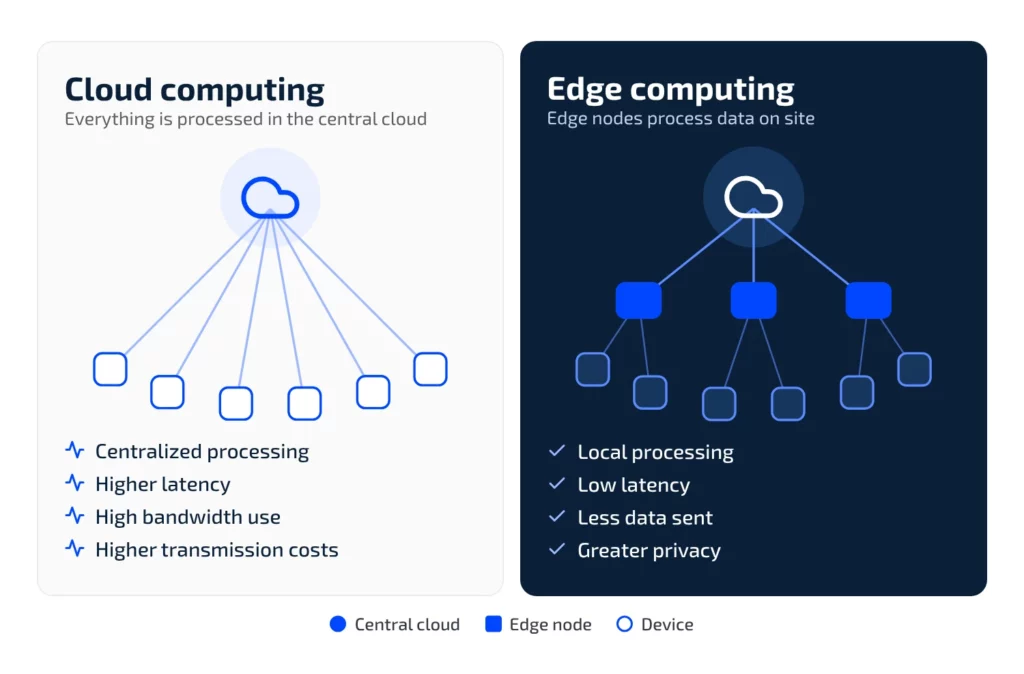
In order for you to understand how Edge Computing works, you should know that its architecture is based on three layers that distribute processing intelligently:
- Edge devices: Sensors, actuators, cameras, PLCs and any element that generates data. These devices capture information in real time and may have basic processing capabilities.
- Edge nodes: Edge servers, IoT gateways or local systems that run applications, AI algorithms and business logic. They process data close to the source and make autonomous decisions.
- Central Cloud: Receive aggregated data, historical analysis and trained AI models. It is used to orchestrate, update and perform predictive analysis at scale.
Practical example: autonomous vehicle
An autonomous vehicle is the perfect example of Edge Computing. It can generate 1 GB of data per second using sensors (LiDAR, radar, ultrasound), cameras and GPS. If you had to send your camera images to a cloud server to ask “is that a pedestrian?” and wait for the response to brake, an accident would be inevitable.
Therefore, the car must process that image locally (Edge) and brake in milliseconds. It will only send a report to the cloud afterwards: “There was a slowdown in these coordinates.” This saves lives and, in the process, reduces data consumption by 95%.
Differences between Edge Computing and Cloud Computing
Here you can clearly see where each one wins, because they are not rivals, but necessary companions.
| Feature | Cloud Computing | Edge Computing |
|---|---|---|
| Processing location | Centralized data centers | Network edge, close to the source |
| Latency | *50-200 ms | *1-10 ms |
| Bandwidth | High consumption | Reduction of up to 90% |
| Data privacy | Data traveling over external network | Local sensitive data |
| Reliability | Connectivity dependent | Works with limited connectivity |
| Scalability | Vertical (more power) | Horizontal (more nodes) |
| Ideal case | Historical analysis, storage. | Real-time decisions, critical IoT |
* Typical/estimated values that depend on the network and architecture.
The ability to grow node by node, adding power right where it is needed without touching core infrastructure, is what makes the Edge so attractive to modern enterprises. In fact, according to Gartner, by 2026 the adoption of Edge Computing applications for new use cases will represent more than 50% of the IT infrastructure opportunity. This data demonstrates the complementarity between both models rather than a total substitution.
You can expand this comparison in our article on the differences between Edge Computing and Cloud Computing.
Advantages of Edge Computing
Let’s now see what benefits Edge Computing brings you when you implement it in your organization.
Reduction of latency and real-time response
As we have seen, one of the main advantages is the reduction of latency from milliseconds to microseconds. In critical applications such as industrial control, robotic surgery or traffic management, every moment counts. Edge Computing eliminates the round trip to the cloud, allowing immediate responses to environmental events.
Optimization of data transmission costs
Processing data at the source reduces bandwidth costs. An oil rig generates data from 30,000 sensors, but less than 1% is used for real-time analysis. The Edge filters and sends only valuable information, reducing transmission costs by up to 80% according to IBM.
The Edge filters and sends only valuable information, with typical reductions between 35% and 60% in enterprise implementations, and can reach up to 75% in scenarios
with advanced optimization.
Greater privacy and control over information
By keeping sensitive data in local facilities, companies better comply with regulations such as GDPR, HIPAA or LOPD. Personal, financial or health data does not leave the perimeter, minimizing the risk of security breaches.
Service continuity even with low connectivity
Edge systems can operate autonomously without constant connection to the cloud. This is vital for critical infrastructure: power plants, hospitals or factories that cannot be stopped due to network failures.
Improved operational efficiency
Local processing enables intelligent automation that does not depend on the central cloud. Thanks to this, factories adjust their production in real time, retailers update inventories instantly and building automation in smart buildings manages energy consumption autonomously and efficiently.
Disadvantages and challenges of Edge Computing
Edge computing, despite its clear advantages, also poses some technical and organizational challenges. Knowing them in advance will help you better prepare for their implementation:
Greater complexity in distributed management
Managing hundreds or thousands of edge nodes requires centralized management. The edge is not about having local servers, but about coordinating a distributed architecture with the cloud. A real problem: when each node runs different versions of the software, failures become unpredictable.
Need for reinforced cybersecurity
The edge is more secure (concentrates less data) but requires reinforced security (multiple
points of attack). The solution requires Zero Trust (continuous validation, multi-factor authentication, encryption), data sovereignty (local GDPR compliance), and centralized security management across the infrastructure.
Initial investment in edge infrastructure
Unlike the cloud model, based on pay per use, the Edge usually involves the purchase and installation of servers and sensors on the premises. Although this generates a long-term return on investment (ROI) thanks to operational savings, it represents an initial economic and logistical barrier to entry that must be considered.
Coordination between edge and cloud
Deciding what you process locally and what you send to the cloud is essential. You need a clear plan. Keeping data synchronized between both environments and updating AI models are technical challenges that you must take into account.
Applications of Edge Computing in different sectors
Edge computing is transforming virtually every industry, with use cases that demonstrate benefits in each of them. Let’s see how this technology is applied in different areas.
Enterprise IoT and smart buildings
In smart buildings, Edge Computing processes data from temperature, occupancy and air quality sensors in real time. A BMS system (Building Management System) with edge technology can reduce energy consumption by 10-30% by reacting to changing conditions without waiting for the cloud.
In the hotel sector, this technology optimizes the air conditioning, lighting and security of multiple establishments by processing data locally, achieving energy efficiency and better operations without depending on centralized connectivity.
Industry and production (Industrial Edge Computing)
Edge Computing is revolutionizing factories by making machines and the digital world work as a team. Thanks to this, cameras and sensors no longer only capture data, but instantly understand what is happening to detect any small defects or prevent breakdowns before they happen.
A clear example is the automotive components company BorgWarner, which has implemented the OTEA platform to monitor machines, air conditioning and energy consumption in its plants in real time. By processing data locally, the system makes automatic decisions without waiting for the cloud, reducing operating costs and improving preventive maintenance through real-time data analysis.
Retail and multi-site chains
Edge computing is the key driver for digitalization in the commercial sector. It allows chains to manage hundreds of stores as autonomous nodes, processing data in situ (video, RFID inventory and queues) without saturating the central network and guaranteeing offline operations.
This operational and data management efficiency explains why retail represented almost 28% of global Edge spending in 2025.
Mobility, cities and transportation.
Autonomous cars process data from their sensors to decide instantly without depending on connections to distant servers.
In cities (Smart City), smart traffic lights adapt to real traffic without having to centralize all the data, while buses and trains monitor their position in real time to improve routes and offer better service.
Health and critical environments
In hospitals, Edge Computing allows continuous monitoring of patients in real time, generating immediate alerts regarding changes in their vital signs.
In addition, it facilitates the local processing of medical images, such as MRIs and CT scans, which drastically shortens waits that are sometimes critical. The value of this technology is perhaps most evident in robotic surgery, where minimal latency ensures precision of movements, a decisive factor during any operation.
In the banking and financial sectors, Edge Computing improves fraud detection by processing transactions in real time without sending all data to remote servers, improving security and regulatory compliance by keeping sensitive information at the perimeter.
Edge Computing and other emerging technologies
Clearly, Edge Computing is not a lone player in today’s technology ecosystem; Its true potential is realized when it is associated with other innovations that are redefining our digital world, especially in the area of IoT (Internet of Things).
Artificial Intelligence
The combination of Edge Computing and Artificial Intelligence (AI) is revolutionizing the way we interact with technology in our daily lives. This union allows us to create truly autonomous systems that make intelligent decisions instantly, without having to wait for a response from distant remote servers.
Ultra-fast connection (5G)
Its union with 5G is creating ultra-fast mobile experiences that were previously science fiction. An augmented reality soccer match where you see statistics overlaid in real time on the players on the field? That immersive experience needs the combination of 5G and Edge to work without noticeable delays.
Secure systems (Blockchain)
It is also partnering with Blockchain to create more secure and transparent decentralized systems. Imagine IoT sensors in the food supply chain that record temperature at every point along the way, storing the measurements in a local, distributed ledger that cannot be altered. In this way, the traceability and quality of the product is guaranteed without depending on a constant internet connection.
Immersive experiences (AR/VR)
Augmented reality (AR) and virtual reality (VR) benefit greatly: by processing data close to the user, VR headsets reduce the feeling of motion sickness by minimizing the delay between the movement of your head and what you see on the screen.
According to IDC, global spending on edge computing solutions is estimated to exceed $250 billion annually, demonstrating that the future is no longer just in a distant cloud, but in the intelligence that resides in our own everyday devices and their local environment.
How to choose an Edge Computing solution
To implement Edge Computing and ensure it truly meets your needs, you need planning. Here are the key points to consider when choosing the right solution:
- Identify processes that require immediacy: Not everything needs the power of Edge Computing. Focus on those critical use cases where latency (delay) directly affects the operation of your business, such as security or industrial production.
- Assess data volume and velocity: If your business generates terabytes of data daily (for example, with high-resolution cameras), the Edge is your best option. It greatly reduces transmission costs by not having to send everything to the central cloud.
- Cost-benefit analysis (ROI): It’s time to crunch the numbers. Calculate your return on investment (ROI) by considering not only bandwidth savings, but also reduced downtime of your systems and overall gains in operational efficiency.
- Compatibility with your current cloudinfrastructure: Integration is key. Ensure your Edge solution integrates seamlessly with your favorite cloud services, whether AWS, Azure, or Google Cloud, for unified management.
- Safety and maintenance requirements: Safety is essential. Always look for solutions that offer robust certifications (such as ISO 27001), end-to-end encryption, and automatically update to avoid headaches.
Conclusion
As we have seen throughout this post, Edge Computing is already here, transforming companies and creating new opportunities around us. It is not a passing trend; it is a reality that, together with AI and 5G, is driving innovation in all sectors.
The figures speak for themselves, with investments growing year after year and more and more organizations processing their data close to where it is generated. But beyond the numbers, what is really exciting are the possibilities that open up: more fluid experiences for your customers, more efficient processes in your business and creative solutions to problems that previously seemed impossible to solve.
The best? You don’t need to transform everything at once. You can start with small pilot projects, learn from the process, and expand when you’re ready. Edge Computing is a journey, not a race, and every step you take will bring you closer to a business that is more agile, intelligent and prepared for tomorrow.
Technology evolves to serve us better, and Edge Computing is a clear example of this. Are you ready to explore how you can supercharge your organization? The future is built with Edge Computing, and you can be part of it!
Recommended for you



You deserve a facility management system that works with you
Request a free demo and discover how other maintenance, sustainability, and energy efficiency teams are achieving real results. No unnecessary complexity. Just a clear roadmap designed to scale with you.



