
How to integrate a BMS with HVAC, lighting and other technical systems
A Building Management System (BMS) only delivers value if it is properly integrated with HVAC, lighting and the building’s other technical systems. An advanced controller that doesn’t communicate correctly with AHUs (air handling units), fan coil units, chillers, lighting circuits or meters ends up working as an isolated data source, with no real ability to act on the installation.
This article explains what that integration involves, what options exist depending on the type of equipment, and what to do when systems already installed don’t use open protocols.
What does integrating a BMS with your systems actually mean?
It’s worth clarifying from the outset that monitoring and controlling are not the same thing.
Passive monitoring means the BMS reads information (temperatures, consumption, run status) without intervening. It provides visibility, but it doesn’t change how the installation behaves.
Active control means the BMS can send commands: adjusting setpoints, switching off a lighting circuit at a given time, starting or stopping HVAC based on actual occupancy or thermal demand. This is the level at which the BMS actually influences how the building is operated. Active control requires two-way communication, and that depends on the protocol the equipment uses. If the BMS can read and write in that “language”, you get real control; if it can only read, it’s limited to observation.
Which systems can be integrated into a BMS?
Practically any technical system in the building can be integrated into a BMS, provided it has a compatible protocol or one can be added to it.
Systems commonly integrated include:
- HVAC and climate control: AHUs, fan coil units, chillers, heat pumps, VRF/VRV systems.
- Lighting: zone-based control or addressable luminaires.
- Industrial refrigeration, and electricity, gas, water or heat meters.
- Other systems such as access control, CCTV, lifts, ventilation or generator sets.
In practice, the limit is set by the equipment’s communication capability and the design of the architecture. To better understand how a BMS fits alongside other systems, it can help to review Differences between EMS, BMS and SCADA.
How does the BMS communicate with HVAC systems?
Communication relies on industrial protocols. The most common ones in buildings are:
- BACnet IP or MS-TP: widely used in HVAC and building automation, found in AHUs, HVAC controllers and control panels from manufacturers such as Siemens, Schneider and Johnson Controls.
- Modbus TCP or RTU: common in energy meters, variable frequency drives and industrial chillers; simple and widely used in existing installations.
- KNX: used in offices for lighting, blinds and HVAC, with interoperability between manufacturers.
- DALI/DALI-2: specific to lighting control, able to address each luminaire individually and report status information.
- M-Bus: common in water, heat and gas meters.
It’s normal for several of these protocols to coexist within the same installation. The BMS, together with the management platform, acts as a convergence point: it unifies scattered data and presents it in a single control environment, so no system is left isolated in its own interface.
What happens when equipment doesn’t use an open protocol?
Many buildings have equipment that uses proprietary protocols understood only by its own control panels.
In these cases, there are two common solutions:
- Add a gateway that translates the proprietary protocol into a standard one such as BACnet or Modbus.
- Install a data logger that captures analogue or digital signals when direct communication isn’t available.
It’s not the most straightforward option, but it usually makes it possible to keep using equipment that is still in good condition, avoiding premature replacement and allowing integration to move forward step by step.
How is lighting integrated into a BMS?
Lighting has its own particularities. It’s typically handled with DALI (very common in commercial buildings) or with KNX when the goal is to coordinate it with other building functions. The current version, DALI-2, allows each light point to be managed individually: dimming, grouping luminaires, reporting status, and integrating occupancy and daylight sensors on the same bus.
When this system is connected to the BMS through a gateway or a compatible controller, it becomes possible to programme automatic scenes based on occupancy schedules or natural light levels, from the same environment used to manage HVAC. This is where BACS (Building Automation and Control Systems) fit in: they bring lighting, HVAC and other subsystems together under a common automation layer, with a direct impact on the building’s energy consumption.
When the building is already in operation
In many projects, the starting point is buildings already in operation, with equipment from different manufacturers and very uneven levels of automation. Budgets don’t always allow for replacing the entire infrastructure, so integration is designed around what’s already there.
In these cases, three scenarios typically come up:
- The equipment already has an open communication module. It connects directly to the BMS using the relevant protocol.
- It has proprietary communication. It communicates with its own control panel, but not with the BMS. A gateway is added to translate it.
- It has no digital communication. External connectivity is used instead: analogue inputs, sensors, control relays or other field-level solutions.
In most projects, the machinery doesn’t need to be replaced. A communication layer is added on top of the existing equipment, allowing integration and control to move forward without losing the investment already made.
What can you automate once the BMS is integrated?
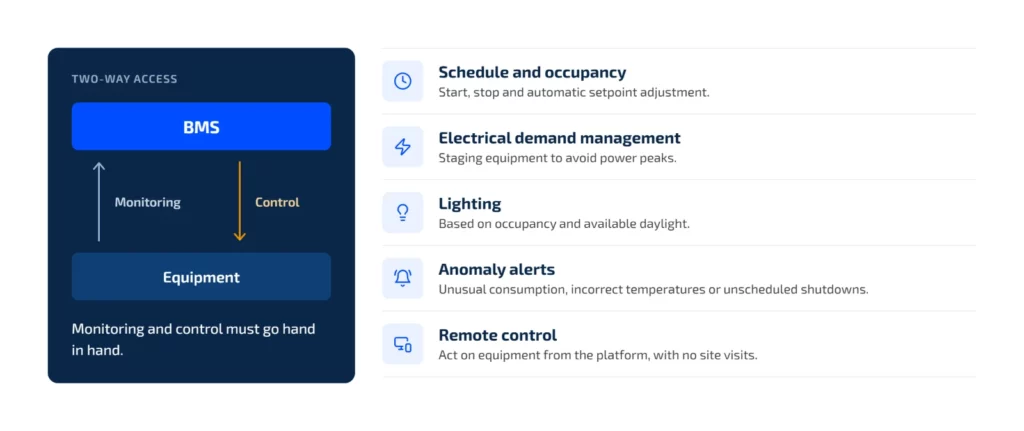
Once the BMS has two-way access to the equipment, you can implement automations with a direct impact on consumption and operation. IoT applied to energy management makes these kinds of strategies easier to deploy:
- Scheduled or occupancy-based start/stop, adjusting setpoints automatically.
- Electrical demand management, staging equipment to avoid the power peaks that push up the bill.
- Occupancy- and daylight-based lighting, switching off unused zones or dimming intensity.
- Alerts for abnormal behaviour, such as unusual consumption, incorrect temperatures or unscheduled shutdowns.
- Remote control and automation of installations, acting on equipment from the platform without needing a site visit.
In every case, the starting condition is the same: monitoring and control need to go together. Without the ability to act, the system is limited to reporting; with integrated control, it can directly support operation and maintenance.
Frequently asked questions
Do we need to replace the HVAC system to integrate it?
Not necessarily. In many cases, adding a gateway or a data logger is enough. Only with very old equipment, with no digital signals available, might additional field hardware be needed.
How long does integration take?
It depends on how much equipment is involved and the existing level of connectivity. A system with Modbus already available can be integrated in a few days, while projects with several heterogeneous subsystems and multiple gateways can take several weeks as part of a broader implementation process.
What’s different between integrating HVAC and integrating lighting?
Mainly the protocol and the level of detail. HVAC typically works with BACnet or Modbus, and control is organised by equipment or by zone. Lighting, using DALI or KNX, allows control down to the level of each individual luminaire, which calls for a more detailed network design and specific gateways if everything is to run on the same BMS.
If you’re weighing up which system to implement, How to choose a BMS covers the technical factors behind that decision. And if you’ve already chosen your system and want to review the full process, How to implement a BMS step by step walks through each phase of the project.
Ultimately, integrating HVAC, lighting and other technical systems into a BMS only pays off once the connection goes beyond simple data collection. That means the right protocol on each subsystem (BACnet, Modbus, KNX, DALI-2, M-Bus), a gateway wherever equipment doesn’t speak an open language, and two-way communication that lets control commands actually reach the equipment. OTEA, the EMOS platform built by EcoMT, is built around that layer: it connects to BMS and field devices over standard and proprietary protocols alike, and turns that connectivity into rules and commands that act directly on HVAC, lighting and other systems, not just dashboards that display them.

Recommended for you

You deserve a facility management system that works with you
Request a free demo and discover how other maintenance, sustainability, and energy efficiency teams are achieving real results. No unnecessary complexity. Just a clear roadmap designed to scale with you.




