
How to Choose a BMS for Your Business

Choosing a building management system (BMS) for your business is about more than adding one more piece of equipment to the installation. It also shapes how you’ll manage HVAC, lighting and other systems for years to come.
It’s not enough for a BMS to display consumption data, statuses or alarms. It needs to let you act on the installation, integrate with what you already have, and make daily work easier for the operations team.
This article looks at the technical criteria worth considering when choosing a BMS, the operational aspects that are often overlooked, and the questions it’s useful to have clear before picking a vendor.
What should you know before evaluating a BMS?
If you’re not yet clear on what a BMS is and how it differs from a SCADA or an EMS, it’s worth reading Differences between EMS, BMS and SCADA first. Without that foundation, any comparison stays incomplete.
It’s also worth starting from one idea: a BMS that only monitors doesn’t, by itself, solve how the installation is operated. Logging data is necessary, but operational performance shows up when that information is used to adjust setpoints, coordinate equipment, automate responses and support maintenance and operations decisions.
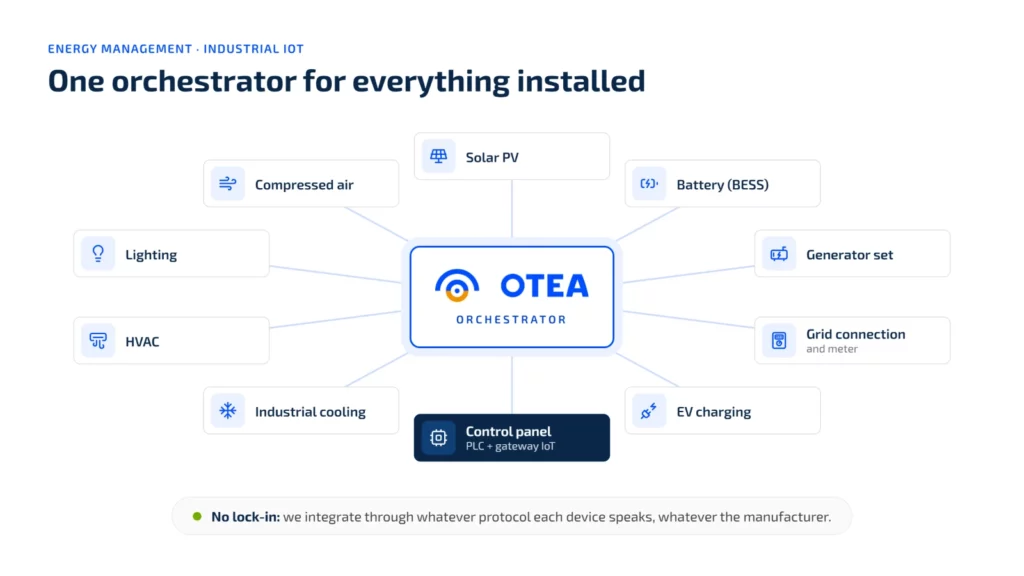
In this context, it’s useful to distinguish a BMS from an EMOS platform. When OTEA, the EMOS platform developed by EcoMT, is presented as an EMOS (Energy Management and Optimization System), it does so as a layer that connects monitoring, control, maintenance and operations, so that energy data ends up integrated into decision-making for the installation.
Technical criteria for choosing a BMS
Communication protocols
A BMS is only useful if it can communicate with the equipment that makes up the installation, or with equipment that will be added in the future. In a real building, several protocols usually coexist at once.
Among the most common are:
- BACnet, common in tertiary-sector buildings and frequently required in technical specifications.
- Modbus RTU or TCP, common in energy meters and industrial machinery.
- KNX, used in office lighting and HVAC.
- M-Bus or DALI, common in metering and lighting systems.
It’s important to ask the vendor which protocols it supports natively and which manufacturers it has proven integrations with. If the system depends on a proprietary protocol or closed integrations, the installation’s ability to grow or add new equipment can end up limited.
Integration with what you already have
A BMS doesn’t operate in isolation. It has to work alongside HVAC, lighting, industrial refrigeration, meters, access control, and even corporate systems such as ERP or CMMS.
If a solution forces you to replace a significant part of what already works, the design is worth a second look. Open architectures, with well-defined APIs and the ability to integrate with different manufacturers, make it easier to leverage existing infrastructure and reduce technology lock-in.
Scalability: what happens as you grow?
It’s unlikely that today’s situation will look the same in five or ten years. New sites may open, self-consumption or EV charging points may be added, or the number of measurement points may simply increase.
That’s why scalability isn’t a nice-to-have, it’s a requirement. In multi-site environments, the platform should let you add new facilities or nodes without redesigning the architecture or driving up licensing costs every time you grow.
Operational aspects many overlook
What happens to the data the system generates
One of the main sources of frustration comes after implementation: the system logs data, but that data never turns into operational decisions. It stays inside the BMS, never cross-referenced with other sources, without useful rules or alerts that allow timely intervention.
That’s why, when evaluating a solution, looking at charts isn’t enough. It’s important to check whether the platform can identify deviations, compare consumption across sites, trigger maintenance work orders, or activate automatic responses when abnormal behaviour is detected.
Ease of use for the operations team
A complex system tends to be underused. If the team constantly depends on the technical department for any adjustment, real usage drops and part of the BMS’s potential is lost.
During a demo, it’s worth observing how the operations team would actually use the tool day to day: managing alarms, changing setpoints, analysing incidents or comparing sites, without needing extensive training for every task.
Regulatory compliance and certifications
The regulatory framework directly shapes automation and control requirements. Spain’s Thermal Installations in Buildings Regulation (RITE) requires, in certain cases, automation and control systems, normally implemented through BACS solutions.
In addition, compatibility with BACS systems and schemes such as CAES can affect a building’s energy rating and its eligibility for certain grants or certifications.
For more context, Building automation myths offers useful background on the role these systems play in improving energy and operational performance.
Common mistakes when choosing a BMS
In practice, the same mistakes tend to repeat:
- Focusing on hardware and neglecting software. Hardware captures and executes; the software layer organises information, defines rules and turns data into action.
- Being guided by the manufacturer’s brand. The name on the controller doesn’t guarantee how the system will actually be used, or what support will be available after implementation.
- Accepting overly closed solutions. Heavy dependence on a single vendor complicates expansions, integrations and future upgrades.
- Not thinking long term. A BMS isn’t replaced every few years; it should support regulatory change, new technologies and business growth for most of its working life.
Questions you should ask any BMS vendor
Before making a decision, it’s worth getting clear answers to questions such as:
- What protocols does it support, and which manufacturers does it integrate with natively?
- Does it include data management software, or does it depend on additional modules?
- Is it scalable if more facilities or measurement points are added?
- What operational support is provided after implementation?
- Is it compatible with BACS systems to comply with RITE?
- How are alerts and maintenance work orders managed when an anomaly is detected?
This last question matters most. If the system detects a problem but doesn’t help route it to whoever needs to act, it stays at the level of supervision. And supervision alone doesn’t change how facilities are managed.
In summary, what a BMS should deliver
Choosing a BMS is, in practice, deciding how your facilities will be managed for the next decade. The technology you need already exists; the difference lies in whether the solution you choose lets you:
- Centralise control of the building’s main systems.
- Integrate different equipment and protocols without creating unnecessary dependencies.
- Support clear, repeatable operations across one or multiple sites.
- Act on the installation, not just observe it.
- Scale as the business or asset network changes.
When this control layer connects with an EMOS platform like OTEA, monitoring and the BMS stop being just data sources and become part of energy and operational management based on clear criteria.

Recommended for you



You deserve a facility management system that works with you
Request a free demo and discover how other maintenance, sustainability, and energy efficiency teams are achieving real results. No unnecessary complexity. Just a clear roadmap designed to scale with you.




