
Edge computing vs cloud computing Differences and when to use each

The debate about Edge Computing versus Cloud Computing is no longer a question of choosing one side or the other. Both technologies cover radically different needs and, in most modern companies that lead their sectors, the smartest approach is usually to combine them.
Before investing in digital infrastructure or signing long-term contracts, you should be very clear about what each model gives you, where one stands out over the other and how you can take advantage of it together. It’s not just about technology, but about the architecture of your business.
If your company is looking for options to move data faster, reduce operational costs, improve customer experience or simply respond instantly to critical failures, our analysis will help you decide which model best fits your business objectives and avoid failed investments.
What exactly are Edge Computing and Cloud Computing?
To understand the relationship between these two concepts, we must first look at how computing has evolved. We’ve moved from centralized mainframes to personal computers, then centralized again with the cloud, and now the balance is swinging back toward decentralization.
Cloud Computing (or the traditional cloud) is what allows you to use servers, databases, networks and software over the Internet, paying only for what you use. Basically, instead of investing (CAPEX) in your own machines, cooling and maintaining them, you rent (OPEX) capacity in remote data centers managed by giants like AWS, Microsoft Azure or Google Cloud.
This model has been the basis of digital transformation in the last twenty years, and with good reason: it democratized access to supercomputing, allowing a three-person startup to have the same infrastructure as a multinational.
Edge Computing, on the other hand, works differently: here data processing is done close to where it is generated, whether in an industrial sensor, an IoT energy management device, a connected car or a local server in a store.
Instead of sending all the raw information to the cloud to be analyzed there, the data is processed at the “edge” of the network, which greatly cuts waiting times and reduces dependence on bandwidth. If the Cloud is the central brain that thinks long term, the Edge is the body’s reflex system: you don’t need to consciously think to remove your hand from the fire, your peripheral nervous system does it for you.
The good thing is that the two models are compatible. In fact, according to Forrester and other large consulting firms, the future of infrastructure is towards “cloud-to-edge” architectures, a computing continuum where centralized and distributed services coexist and collaborate according to what you need at any given time.
Both models are developed in greater depth in our specific articles on what is Cloud Computing and what is Edge Computing.
How does each model work?
Understanding the internal mechanics is vital to making architectural decisions, because the physics of the data matters.
Cloud computing is powered by huge, centralized data centers, often the size of several football fields. When you use the cloud, your data travels through your local network, out to your internet provider, across the backbone and sometimes across oceans, until it reaches these centers. There they are processed, stored and the response returns in the opposite direction. This allows you almost infinite scalability, because you can request more or less resources as needed without having to buy physical hardware. It is raw power on demand.
Edge computing, on the other hand, distributes the work at many points close to the action. It’s not a single place, it’s a distributed topology. Devices at the perimeter (smart cameras, vibration sensors, local servers or gateways) capture the information and analyze it instantly. It acts as a first intelligent filter. Only the data that really matters (insights) or that is already processed is sent to the cloud, to be saved or analyzed later. This system makes the difference when every millisecond counts or when sending all data is economically unfeasible.
Main differences between Edge and Cloud Computing
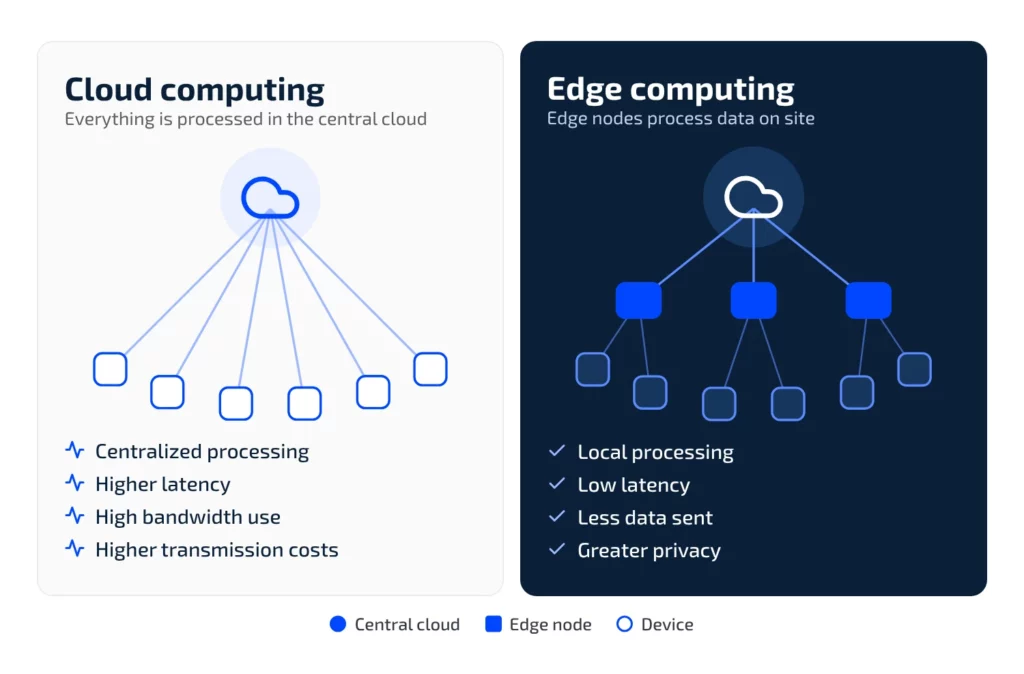
Let’s now see how Edge Computing and Cloud Computing differ in terms of processing location, latency, connectivity and storage.
Location of data processing
The most basic difference is the physical and logical location. Cloud Computing takes it to large data centers that can be hundreds or thousands of kilometers away, detaching the user from the physical hardware. You don’t know where exactly the server is, and you don’t care as long as it’s performing well.
Meanwhile, edge computing puts computing power as close to the source as possible, being fully “location aware.” And this changes almost everything else, from safety to speed.
Latency and response speed
Here is the main difference. Latency is the time it takes for a data packet to go and return. At the Edge, since the data does not travel far (sometimes only a few meters by cable or local Wi-Fi), the response is practically instantaneous, a matter of milliseconds or even microseconds. The cloud, relying on sending and receiving data from remote servers over multiple routers and network hops, has higher and more unpredictable latency. It doesn’t matter to send an email, but if you need real-time decisions (like braking an autonomous car), it can be a serious problem.
Dependency on connectivity
For the cloud to work correctly, you need stable and fast internet no matter what. It is an “always connected” model. Without connection, you are left in the dark and your applications stop working. Edge Computing, however, can continue working even if the network goes down, because it processes locally. This is vital in remote sites, rural areas, basements or industrial environments where coverage comes and goes or where a fiber outage cannot stop production.
Storage and scalability
If we talk about storing data in a big way (Big Data, Data Lakes), the cloud wins by a landslide: you can manage petabytes without buying a single hard drive and retain data for decades. Edge computing prioritizes speed over raw capacity; It usually has limited and rotating storage (saves the last 24 hours and deletes the previous ones). Additionally, scaling at the Edge is slower and more expensive, because it involves logistics: putting up more physical devices, installing and wiring them, not just clicking on a website to add virtual resources.
Advantages of Edge Computing over the Cloud
In this section we review the main advantages of Edge Computing compared to the Cloud when immediacy, privacy and efficiency in the use of the network is needed.
Real-time processing
As we said, the strong point of Edge Computing is that it processes information instantly, without waiting for the data to travel over the public network. The systems can make decisions in milliseconds, something basic for autonomous cars, drones or collaborative industrial robots. According to Grand View Research, the global Edge Computing market will grow 36.9% annually until 2030 precisely because of this need for immediacy that the cloud, due to pure physics, cannot offer.
Greater privacy and security of sensitive data
By processing on-site (“on-premises”), Edge Computing reduces the risk of exposing sensitive information on external networks or public clouds. Raw data (images of faces, medical data, trade secrets) does not leave your controlled environment. This facilitates compliance with regulations such as the GDPR or the LOPD. In sectors such as health, banking or defense, this is non-negotiable: data sovereignty remains within your walls.
Autonomous offline operation
Edge computing allows everything to continue moving, even if the internet goes down. In a remote factory, underground mine or oil platform, this independence avoids downtime with a direct impact on production and operating costs.
The equipment operates autonomously, saves the data in a local buffer and will upload it for the historical report when the connection returns.
Bandwidth optimization
Imagine a 4K security camera recording 24/7. Uploading that to the cloud costs a fortune and saturates your network. Because you filter and process at the source with edge computing, you send much less irrelevant information to the network. The camera analyzes the image and only sends a text alert or short clip if it sees something strange. Only what is important travels, which lowers the cost of transmission (data egress charges) and avoids clogging the lines. Essential if you have hundreds of cameras or sensors sending data.
Advantages of Cloud Computing over Edge
While Edge Computing is great for reducing latency, the Cloud is still the best option when you need real power. Its processing capacity, ease of scaling and savings on infrastructure make it the ideal solution for these reasons:
Infinite scalability on demand
The cloud lets you raise or lower power instantly thanks to its elasticity. If you have a peak of work (like a Black Friday in an e-commerce), multiply your capacity in minutes and you can reduce it the next day, paying only for what you use during that peak. Without buying equipment that would then sit collecting dust for the rest of the year.
Lower initial implementation costs
Unlike Edge Computing, which forces you to buy equipment, install and maintain it (CAPEX), the cloud saves you that heavy initial investment. You start small and go up (OPEX). According to IDC Research, companies that use the cloud can reduce their IT costs by up to 40% compared to having their own physical servers, by eliminating barriers to entry and hardware maintenance costs.
Artificial intelligence and advanced analysis
The Edge can run AI, but the Cloud is where the AI “learns.” Cloud providers give you Big Data and AI tools whose independent development would have costs and complexity that are difficult for most organizations to assume.
You can analyze huge volumes of historical data to see patterns, train complex models, and make long-term strategic decisions. It is the analytical brain of the company.
Global access and facilitated collaboration
With the cloud, your data and applications are available wherever there is internet and credentials. This makes it easy for teams around the world to collaborate in real time and work with the same up-to-date information, breaking down local information silos. If you have people remotely or based in several countries, this is essential for operation.
Delegated maintenance and automatic updates
The provider (Amazon, Google, Microsoft) is responsible for updating operating system security, replacing failed hard drives, and keeping servers powered and cooled, not you. This frees your IT team to focus on developing applications, services and enhancements that truly add value to the business, rather than spending time on routine maintenance tasks.
Limitations of each model
Neither model is perfect. Edge Computing requires an initial investment in hardware and is much more complex to manage at a logistical level: you have many geographically dispersed points that you must physically and digitally protect from cyberattacks. Updating the software of 5,000 sensors is more difficult than updating a central server.
In different surveys by IDC and other analysts, many companies point out that the main challenges of the Edge are both the complete deployment of the solution and the cybersecurity and physical security of the devices, above aspects such as individual hardware.
For its part, Cloud Computing can be expensive if you do not control consumption (the famous “bill shock”), presents latencies incompatible with critical real-time applications and makes you dependent on having a good connection and the provider you choose (risk of “vendor lock-in”). Additionally, you lose some control over where your data basically resides.
When you are interested in using Edge Computing
Edge computing is the most appropriate option when your company needs:
- Critical decisions: When you need decisions in real time and can’t wait. An autonomous car cannot send data to the cloud and wait to be told whether to brake for a pedestrian; every millisecond counts.
- Industry 4.0: It is ideal in industry, where detecting a defect in the production line or monitoring machinery must be immediate to stop a robotic arm before it causes damage.
- Health: To monitor patients in real time, where an instant arrhythmia alert is vital and cannot depend on hospital Wi-Fi.
- Disconnected environments: If you are in a place with unreliable internet (ships, mines, rural agriculture) or handle very sensitive data that cannot leave your facilities by law, Edge Computing gives you that control and autonomy.
When are you interested in using Cloud Computing
Cloud Computing is the best option for mass storage, collaboration and deep analysis:
- Big Data and History: When you need to save and analyze large amounts of historical data or use complex artificial intelligence to define long-term strategies.
- Variable loads: It is perfect if your demand for resources changes a lot, because you scale without spending on your own infrastructure.
- Startups and growth: Also for companies that grow quickly and want to start with controlled and predictable costs.
- Global collaboration: If your team is distributed and needs to access information from anywhere (CRM, ERP, documents), the cloud makes life easier.
- Focus on the business: And if you prefer to let others take care of the heavy technical maintenance so you can focus on your core business, the cloud takes that weight off your shoulders.
When to combine Edge and Cloud Computing
The reality is that many companies get the best of both worlds with hybrid architectures. The combination of both technologies gives you the speed of local processing and the analytical power of the cloud. It’s not “Edge OR Cloud”, it’s “Edge AND Cloud”.
For example, in retail: the cameras in a supermarket analyze the flow of people at the moment (edge) to open checkout lanes if there is a queue, while the cloud cross-analyzes this data to optimize the stock of the entire chain and predict purchasing trends.
In factories, Edge devices instantly monitor quality and stop faulty machines, and the cloud analyzes data from all plants to see how to improve efficiency or energy management on a global level (predictive maintenance).
In hotels, the Edge adjusts the air conditioning room by room depending on whether there are people inside (immediate savings), and the cloud analyzes the energy expenditure of all hotels to negotiate electricity rates and save costs.
Banks use Edge at ATMs for fast and secure transactions, and the cloud to detect complex fraud by learning from millions of global transactions.
According to IDC, spending on edge computing solutions will be around $261 billion in 2025 and will rise to $380 billion in 2028. Come on, it’s not about replacing the cloud, but rather complementing it to create a more efficient digital ecosystem.
How to choose the right model for your company
There is no magic formula or single answer; The ideal decision depends entirely on what your business is like and what point of digital maturity you are at. To clarify, it is best to ask yourself these questions:
1. How quickly do you need to react?
Think about speed. If your processes are critical and require a response in milliseconds, the Edge is your best option. But if you can afford to wait a few seconds without anything serious happening, the Cloud will serve you perfectly.
2. How sensitive is your data?
If you handle very private information or are subject to strict regulations, it is generally better to process everything “in house” (Edge). If you don’t have those ties, the Cloud is a very efficient and secure option.
3. How is your internet connection?
This point is vital. If your connection is unstable, expensive or downright bad, the Edge gives you the autonomy you need to continue operating. On the other hand, if you enjoy good fiber optics, the Cloud will give you incredible flexibility.
4. How do you plan to grow?
Look to the future. If you anticipate sudden spikes in demand and need to scale suddenly, the Cloud is elastic and adapts instantly. If your growth is going to be more predictable and linear, investing in Edge may be more profitable in the long term.
5. What team do you have?
Don’t forget the human factor. Managing a distributed edge network requires technicians who know about networking, hardware, and security. If you are short on staff, it may be more sensible to delegate that load to the Cloud.
In the end, many companies discover that the secret is to combine both models to create technology that truly drives business. If you are thinking about how to manage energy and digitize your facilities, platforms like OTEA are ideal: they help you integrate the IoT, processing at the Edge when speed is needed and centralizing everything in the Cloud to optimize your buildings efficiently.
Recommended for you



You deserve a facility management system that works with you
Request a free demo and discover how other maintenance, sustainability, and energy efficiency teams are achieving real results. No unnecessary complexity. Just a clear roadmap designed to scale with you.



