
Measures to reduce your company’s carbon footprint

Sustainability is no longer that nice extra that we put on the corporate website out of commitment. Right now, it is a strategic necessity. With the entry into force of Royal Decree 214/2025, the rules of the game have changed and companies have the obligation to calculate, record and, what is more delicate, make public their actions to reduce emissions. But, and here comes the interesting thing, beyond the fact that regulations force us, there is an economic reality that we cannot ignore: managing the carbon footprint of your business is, basically, managing your operating costs.
In fact, companies that have put their efforts into optimizing their energy consumption are seeing average savings of 10-15% in the first year alone. So reducing your footprint is not just a decision to “save the planet”; It is a direct investment in efficiency, in being more competitive and in being able to enter markets where, if you are not sustainable, you are simply not viable.
What are we talking about when we say “business carbon footprint”?
To understand us, the carbon footprint is the total trace of greenhouse gases (GHG) that your organization emits, either directly or indirectly, while it operates. This is measured in metric tons of CO₂ equivalent and measures a company’s contribution to climate change across its entire value chain.
But be careful, the fundamental thing here is to understand that measuring the footprint is not the goal, it is just the starting point. This calculation allows you to identify your main emission sources, set objectives that can be met and demonstrate to your clients, investors and the regulator that you are making progress. If you don’t calculate it, any strategy you have is just a good wish, not a serious plan.
This is why Royal Decree 214/2025 is so important: it forces large organizations to measure and communicate their emissions publicly. And one fact to keep in mind: starting in January 2026, the trend is for banks, under regulatory and sustainability guidelines (ESG), to begin requesting verified decarbonization plans before providing financing.
In addition, measuring your carbon footprint does not only serve to comply with a standard or improve your image. It is a concrete way to contribute to the Sustainable Development Goals, especially SDG 13 (Climate Action) and SDG 12 (Responsible Production and Consumption). In other words, every step you take to reduce your emissions also adds to the global effort to stop climate change and build a more balanced and sustainable economic model.
How to calculate the carbon footprint of a company
Calculating the carbon footprint has a standard method, which uses a formula that seems simple: Activity Data × Emission Factor = Carbon Footprint. On paper it sounds easy, but the complicated part is getting data that is accurate and knowing how to classify it correctly.
Differentiating the origin: direct and indirect emissions
First, we must make it clear that emissions are divided according to their origin. The direct are those that your company controls and generates: the natural gas from the boiler, the diesel that you burn or the fumes from your own fleet of vehicles. The indirect, on the other hand, are those that are generated by third parties for you to function, such as the production of the electricity that you buy from your supplier.
Differentiating its origin is essential, because it defines where and how you can act to reduce your impact.
Electricity consumption and associated emissions
In most companies, electricity is the one that has the greatest impact on the carbon footprint. To calculate your emissions, multiply your kWh by your supplier’s emission factor. Imagine that you have spent 350 kWh in a month and the factor is 0.41 kg CO₂/kWh; Well, your emissions would be 143.5 kg of CO₂.
The important thing here is that each energy supplier has different emission factors depending on its energy mix. A company that buys 100% renewable electricity will have a factor close to zero, while one that consumes conventional energy (of fossil origin) will have much higher values. That difference changes everything.
What data do you need for the calculation?
For an accurate calculation, you must collect annual information on electricity, fuels (gas, diesel), car use, work trips, water, waste and freight transport. And be careful, the data has to cover an entire year and be as accurate as possible.
Platforms like DATADIS allow direct access to electricity consumption data without going through the supplier, without having to fight with the supplier.
Commonly used tools and emission factors
The standard that rules internationally is the Greenhouse Gas Protocol (GHG), which defines three emission scopes. To obtain accurate and updated emission factors, official databases such as that of the Ministry for the Ecological Transition or ISO 14064-1 methodologies are used. There is specialized software that automates the process, multiplying your activity by standard factors so that everything adds up and is traceable.
Main sources of emissions in a company
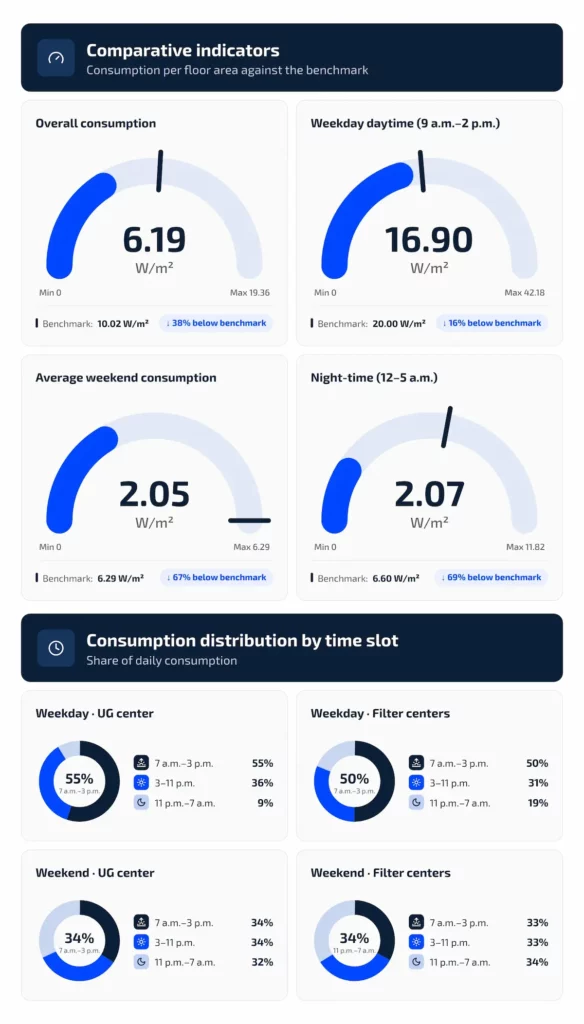
Once you have calculated your global impact, the next challenge is to identify where your biggest “leaks” are to intervene directly at the source. Although each company is unique, there are emission patterns that are repeated in almost all sectors:
1. Energy in buildings and facilities
For almost any service company, energy consumption of buildings (lighting, air conditioning, electrical equipment) is the main source of emissions. An old building, without good thermal insulation and inefficient air conditioning can consume 2 or 3 times more energy than an optimized one. This is where there is usually a faster return on investment.
2. Machinery and industrial processes
Factories have the extra of their production processes, refrigerants, compressed air and heavy machinery. These processes often operate 24/7, so specialized audits are needed to identify opportunities for efficiency.
3. Logistics, mobility and fleets
Both the transport of goods and employee travel represent a critical source of emissions, especially in companies with their own vehicles. Remember that the Sustainable Mobility Law obliges companies with more than 200 employees to design sustainable mobility plans, encouraging staff to use less polluting means than cars particular.
4. The supply chain
Scope 3 emissions usually represent the largest percentage of the total footprint, although it is the most difficult to measure and control. It includes all indirect greenhouse gas (GHG) emissions that occur in a company’s value chain (the transport of your suppliers, production of raw materials and distribution of final products).
5. Waste and treatment of materials
Finally, the generation of waste and its final treatment generate emissions both in its transport and in its processing. A circular strategy that reduces waste at the source directly reduces these emissions.
Measures to reduce your footprint
Okay, now you have the map of your emissions. Now it’s time to act. The measures that work best combine short-term results with long-term transformation:
Optimization of energy consumption
- Efficiency in air conditioning, lighting and equipment: Air conditioning and lighting are responsible for 40%-60% of energy consumption in buildings. Change old equipment for high energy efficiency equipment, install heat pumps that operate at 400% efficiency, replace incandescent lamps with LED (which reduce consumption by up to 60%), and implement automatic control systems based in occupancy and natural light are low risk measures with ROI of 2-4 years.
- Replace obsolete technology: Old equipment operates at a fraction of its potential efficiency. An old combustion boiler may operate at 60% efficiency; a modern one reaches 95%. This change, although it requires initial investment, is quickly recovered through lower energy costs.
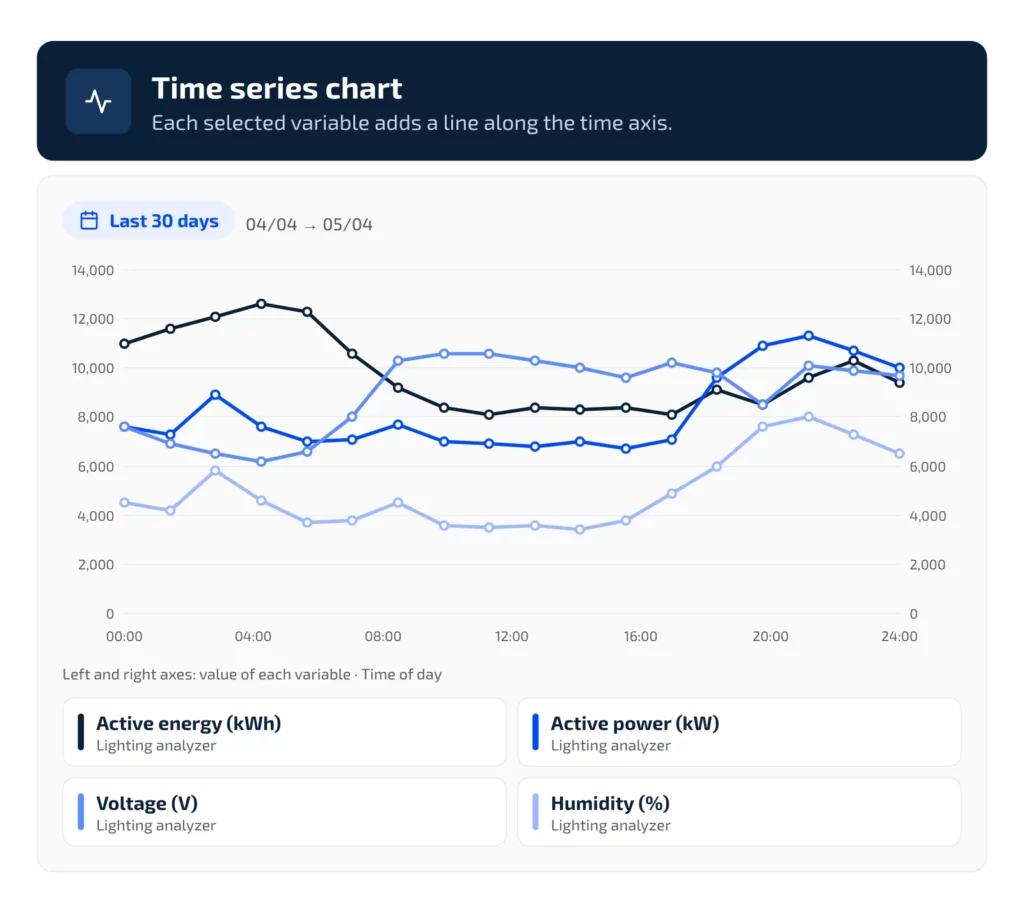
- Monitor in real time: If you don’t see what you spend, you can’t manage it. Platforms that use IoT and data analysis make it possible to identify anomalies, phantom consumption and savings opportunities that would go unnoticed. Retail companies have managed to reduce consumption between 15-20% simply by monitoring in real time.
Reduction of electricity consumption linked to CO₂
- Adjust schedules: If you pay for power, adjusting peak consumption schedules to avoid peaks can generate direct savings.
- Elimination of phantom consumption: Many companies have equipment on “just in case” or oversized emergency lights. The audits identify these energy waste which can account for 5-15% of total consumption.
- Detect inefficiencies and deviations: Automatic systems generate alerts when equipment operates out of schedule or performance drops. A leaking compressor or a dirty filter wastes much more. Predictive maintenance avoids these invisible cost overruns.
Switch to renewables
- Green energy certificates: Buying certified energy is the fastest if you cannot install panels.
- Solar self-consumption and purchase of clean energy: Installing your own panels gives you energy with zero emissions. If you don’t have space, solar communities are a real option. Once installed, energy costs are dramatically reduced for 25+ years.
Improve processes and automate
- Intelligent facility control: The BMS systems automate and control the functions of a building to make it more efficient and comfortable. Typical reductions: 10-30%.
- Sensors and IoT to save energy: Temperature, light and CO₂ sensors feed algorithms that optimize everything. In healthcare, this has achieved savings of 15-20%.
Mobility and corporate transport
- Sustainable mobility policies: The law requires large companies to prioritize public transport, bicycles and teleworking. In addition, this attracts young employees and saves parking costs.
- Electrify the fleet: Changing diesel for electric is a trend. The investment is recovered in 5-7 years due to savings in fuel and maintenance.
Waste management and reduction
- Circular economy and internal reuse: Reusing internally reduces both waste and the need to purchase new materials. The circular economy is more profitable: reusing costs less than manufacturing from scratch.
- Fewer “dirty” materials: Auditing what you buy to avoid materials with a high footprint (steel, cement, new plastics) reduces your Scope 3.
Supplier and supply chain involvement
- Selection of suppliers with environmental criteria: Working with suppliers that already manage their footprint multiplies your positive impact.
- Joint impact measurement: Collaborating with your key suppliers to see where they can save creates value for both of you. This is especially important in sectors with long chains (retail, manufacturing).
Medium and long-term strategies
Immediate measures generate quick savings, but to achieve a true transformation you need planning:
- Energy audit and annual roadmap: An audit (carried out according to IDAE protocol or other standards) tells you where to improve and how much it will cost you. Reviewing the roadmap every year keeps you on track.
- Decarbonization plan: RD 214/2025 calls for 5-year plans. They have to be public and with clear objectives (e.g. drop 30% in 5 years).
- Implementation of continuous improvements: A plan is not enough. You have to measure, analyze and improve. Monitoring systems that alert about deviations allow adjustments in real time.
- Monitoring KPIs and ESG reporting: Clear metrics such as total emissions, emissions per employee, emissions per € of turnover, and % renewable energy facilitate monitoring and build trust with investors.
Business benefits of reducing the carbon footprint
Let’s be honest: taking care of the planet is essential, but a company also needs to be profitable to survive. The good news is that reducing the carbon footprint has ceased to be just a matter of “image” and has become a real strategic advantage.
- Direct reduction of energy costs: optimizing processes and consumption usually lowers the operating bill by 10-30%. In a medium-sized company, we are talking about €100,000 to €500,000 per year. This is one of the most effective strategies to protect profit margins in the face of volatile energy and raw material prices.
- Access to certifications and regulatory compliance: Complying with regulations such as RD 214/2025 avoids legal headaches. Additionally, if you have real estate, you can get certifications such as LEED or BREEAM that revalue your buildings and make them more attractive to rent or sell.
- Better corporate reputation: 86% of millennials (and Generation Z behind them) analyze the sustainability of a company before deciding whether to work for it or invest their money. If you want the best people on your team and loyal customers, your environmental commitment is your best letter of introduction.
- Increased competitiveness and access to tenders: Large corporations have strict climate objectives and demand the same from their entire supply chain. If you don’t have a decarbonization plan, you risk being left out of important public tenders and private contracts.
How digital solutions help you reduce emissions
Trying to manage your carbon footprint manually is an impossible mission. Digitalization is not a luxury, it is the only viable way to scale your efforts.
This is how technology does the heavy lifting for you:
- Energy management platforms to control consumption: Forget about scattered spreadsheets. These platforms centralize your data in real time and allow you to compare buildings with each other. Instantly detect which is efficient and which needs adjustment.
- Automation systems in buildings and facilities: Smart buildings adapt temperature, lighting and equipment operation in real time according to occupancy and conditions. This eliminates arbitrary decisions and continually optimizes.
- Predictive maintenance (Early detection): Sensors and AI identify anomalies (equipment operating outside of normal cycles, degraded performance, unexpected peaks) before they become serious problems or breakdowns.
- Use of data to continuously reduce emissions: Machine learning algorithms identify patterns of inefficiency that the human eye cannot see. They transform millions of data into clear strategies to know exactly where and how to save more.
OTEA and EcoMT: support for companies that want to reduce their carbon footprint
For companies that want to move from data to action, OTEA is a platform specialized in energy management that integrates IoT, data analysis and AI.
- How energy monitoring facilitates meeting objectives: OTEA connects sensors, smart meters and control systems on a single platform. View consumption by building, area, equipment or person, in real time. This allows us to identify the 20% of the equipment responsible for 80% of the consumption and intervene there first.
- Automation to reduce consumption and emissions without losing operability: The platform automates decisions (turn off lights in empty areas, adjust air conditioning according to occupancy) without requiring manual intervention. Systems run more efficiently while freeing human teams from repetitive tasks.
- Real cases of energy optimization and reduction CO₂: OTEA clients have obtained savings of 15-20% in energy, which translates into a 10-15% cut in Scope 2 emissions. Sectors such as retail, hotels or industry demonstrate that these figures are totally viable.
If your objective is to convert the sustainability strategy into measurable results, both in economic return and in metric tons of CO₂ avoided, it is time to request an evaluation or analysis of savings opportunities.
The change is here
Royal Decree 214/2025 is not the end of the road, it is the official confirmation that decarbonization is a strategic pillar. Companies that understand this not only comply with the standard; They manage their costs better, attract talent and obtain better financing.
Don’t leave the management of your footprint for tomorrow; The market demands it today. Those who are one step ahead already know that measuring, acting and communicating your progress not only improves your reputation and attracts investment, but also ensures leadership for the next decade.

Recommended for you
You deserve a facility management system that works with you
Request a free demo and discover how other maintenance, sustainability, and energy efficiency teams are achieving real results. No unnecessary complexity. Just a clear roadmap designed to scale with you.




