
Food Cold Chain Regulations in Spain: Temperatures, Controls and Responsibilities


The cold chain is the set of conditions that keeps chilled or frozen food at the right temperature from production until it reaches the consumer. If it breaks, microorganisms can multiply and the product may become unsafe even when it looks unchanged.
No single law governs the cold chain in Spain. Requirements are spread across EU hygiene regulations, a Spanish decree for food retail and an international agreement on transport. Each rule sets temperatures by product and stage, and addresses foods without a specific legal temperature. This article explains what each requires, the temperatures it sets and who is responsible.
Which laws govern the food cold chain?
The framework has several layers. EU regulations set general hygiene principles and requirements for products of animal origin. Spanish law specifies conditions for shops, supermarkets and food service. Transport has its own technical framework for temperatures and vehicle types.
Regulation (EC) No 852/2004 on the hygiene of foodstuffs
This is the basic hygiene regulation for all food business operators in the European Union. Two of its requirements directly affect the cold chain.
First, raw materials, ingredients and products likely to support the growth of pathogenic microorganisms or the formation of toxins must not be stored at temperatures that pose a health risk. The regulation explicitly states that the cold chain must not be interrupted. It allows limited periods outside temperature control for practical handling during preparation, transport, storage, display or service, provided they do not create a health risk. Thawing must also minimise microbial growth.
Second, each operator must apply procedures based on HACCP principles (Hazard Analysis and Critical Control Points). In practice, this means monitoring and recording temperatures and taking action when they deviate, as well as maintaining them.
Regulation (EC) No 853/2004 for food of animal origin
This adds specific requirements for meat, fishery products, milk, eggs and live bivalve molluscs. It gives temperatures for individual products: meat from ungulates at 7 °C or below, offal at 3 °C or below, poultry meat at 4 °C or below and minced meat at 2 °C or below. Fresh fishery products must be kept at a temperature approaching that of melting ice, and frozen fishery products at –18 °C or below throughout the product.
It mainly applies to establishments that produce and process food, including slaughterhouses, cutting plants, factories and fish markets, although its values provide a reference along the supply chain.
Royal Decree 1021/2022 for food retail in Spain
Applicable since 22 December 2022, this decree regulates food hygiene in retail establishments, including butchers, fishmongers, supermarkets, restaurants and hospitality venues. It is the key rule at the point of sale. It sets food storage temperatures for retailers, conditions for freezing, thawing and refreezing, and specific requirements for prepared meals, minced meat, fishery products and foods made with eggs.
The ATP Agreement for the transport of temperature-controlled food
The ATP Agreement on the International Carriage of Perishable Foodstuffs and on the Special Equipment to Be Used for Such Carriage was signed in Geneva in 1970 and remains in force. It defines the vehicles that may carry perishable food and the maximum temperatures to be maintained at any point in the load during loading, transport and unloading. In Spain, Royal Decree 237/2000 sets technical specifications and conformity checks for vehicles carrying food under temperature control, in line with ATP, including domestic transport.
Quick-frozen foods are also subject to Regulation (EC) No 37/2005, which requires air-temperature recording instruments in transport vehicles and storage facilities.
What temperatures do food regulations require?
The rules do not set one temperature for everything labelled “chilled” or “frozen”. They specify values by product and sometimes by situation. One refrigerated display may contain foods with different limits, and the strictest applicable limit takes precedence.
Storage temperatures by food type
| Food type | Temperature | Situation or condition | Applicable rule |
|---|---|---|---|
| Meat from domestic ungulates and large game (except ratites) | ≤ 7 °C | Storage and sale | Royal Decree 1021/2022 · Reg. 853/2004 |
| Offal | ≤ 3 °C | Storage and sale | Royal Decree 1021/2022 · Reg. 853/2004 |
| Poultry, lagomorphs, small game and ratites | ≤ 4 °C | Storage and sale | Royal Decree 1021/2022 · Reg. 853/2004 |
| Meat preparations | ≤ 4 °C | Storage and sale | Royal Decree 1021/2022 · Reg. 853/2004 |
| Minced meat | ≤ 2 °C | Storage and sale | Royal Decree 1021/2022 · Reg. 853/2004 |
| Fresh fishery products, unprocessed thawed fishery products, and chilled cooked crustaceans and molluscs | Close to the temperature of melting ice (0–4 °C) | Storage and display | Royal Decree 1021/2022 · Reg. 853/2004 |
| Live bivalve molluscs and live fishery products | A temperature that does not compromise safety or viability | Storage and display | Royal Decree 1021/2022 · Reg. 853/2004 |
| Raw milk | 1–4 °C | Food retail | Royal Decree 1021/2022 |
| Filled pastries not stable at room temperature | ≤ 4 °C | Food retail | Royal Decree 1021/2022 |
| Cut or peeled fruit and vegetables, and unpasteurised juices made on site | ≤ 4 °C | Ready to eat | Royal Decree 1021/2022 |
| Chilled prepared meals | ≤ 4 °C / ≤ 8 °C | Consumed after / within 24 hours | Royal Decree 1021/2022 |
| Hot prepared meals | ≥ 63 °C | Held until service | Royal Decree 1021/2022 |
| Food containing eggs or egg products not stable at room temperature | ≤ 8 °C | Consumed within 24 hours | Royal Decree 1021/2022 |
| Frozen and quick-frozen foods | ≤ -18 °C | Retail storage | Royal Decree 1021/2022 |
| Meat (excluding offal) / offal / butter | ≤ 7 °C / ≤ 3 °C / ≤ 6 °C | Chilled transport | ATP |
| Frozen fish and quick-frozen foods generally / ice cream | ≤ -18 °C / ≤ -20 °C | Frozen transport | ATP |
| Other frozen products (except butter) | ≤ -12 °C | Frozen transport | ATP |
The table covers the main values, not every case. Some products have their own rules, such as fish intended to be eaten raw and freezing to control Anisakis. Always consult the current legislation in Spain’s Official State Gazette (BOE) and the EU Official Journal. ATP also allows –12 °C for certain frozen foods in transport, whereas the general retail storage limit is –18 °C. Each stage has its own value.
What if no legal storage temperature is specified for a food?
Many chilled products do not appear in a temperature table, including cheese, yogurt, sliced cured meats and packaged meals. They still have a storage temperature that must be respected.
In these cases, Royal Decree 1021/2022 refers to the temperature on the label, set by the producer and packer under its food safety system. For foods prepared on site, the operator must define a temperature through its own hazard analysis, applying the general principle in Regulation 852/2004: do not store food at temperatures that may pose a health risk.
At which stages must the cold chain be maintained?
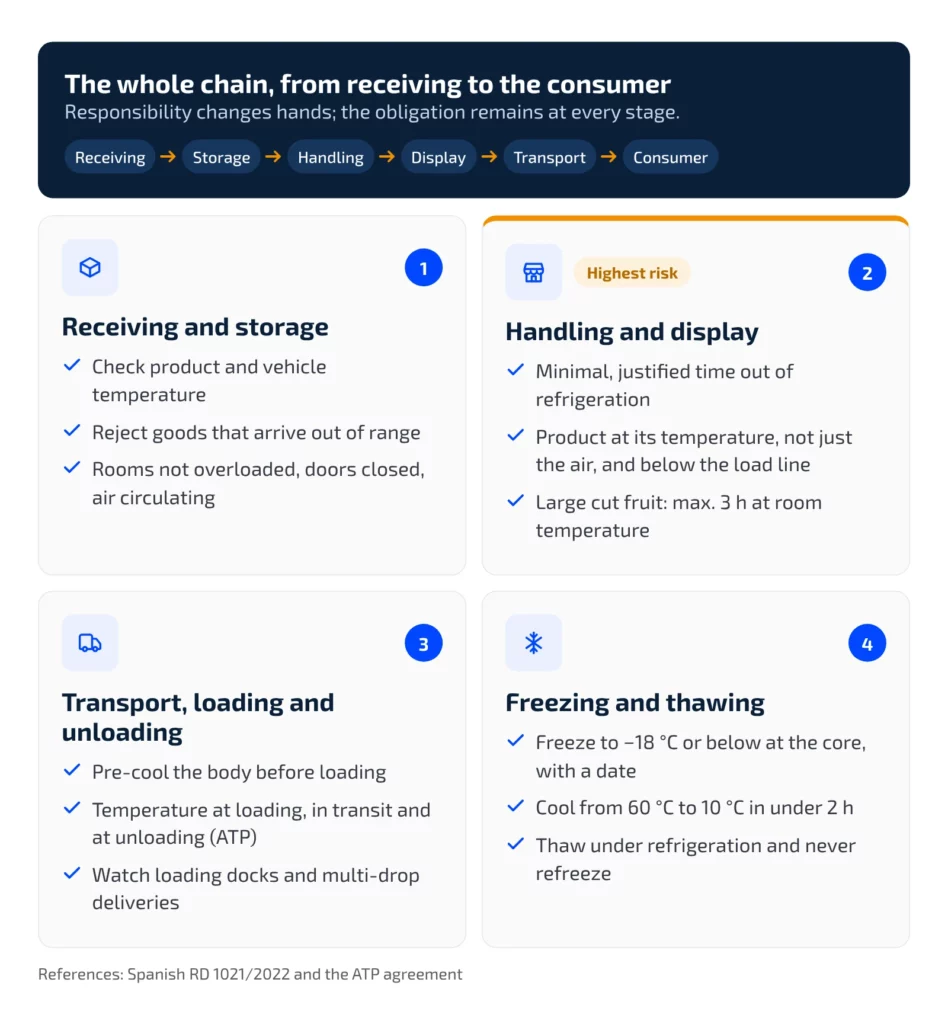
The cold chain must be maintained at every stage, from receiving goods to handing them to the consumer. Responsibility changes hands along the way, but the requirement applies throughout.
Receiving, storage and preservation
Receiving is the establishment’s first control point. Check the product and vehicle temperatures, reject goods that arrive out of range and move accepted products into cold storage without delay. During storage, cold-room temperature depends on both the equipment and how it is used. Overloading, doors left open during restocking or stock obstructing airflow can cause deviations even when the equipment works correctly.
Food handling and display
This is the stage with the greatest risk of a cold chain break, as products leave the cold room for cutting, packing or restocking. Time outside refrigeration should be kept to the minimum needed and justified. Displays and cabinets must keep the product itself at the required temperature, rather than only the air in the unit, and must not be loaded above the fill line. Royal Decree 1021/2022 includes specific cases: large cut fruit such as melon, watermelon, pineapple or papaya may be displayed at room temperature for no more than three hours.
Transport, loading and unloading
Chilled food must travel in vehicles suited to the required temperature, with the cargo compartment pre-cooled before loading. Under ATP, the product must be at the required temperature when loaded, throughout the journey and when unloaded. Loading bays and multi-stop deliveries are common risk points because goods may wait during handover and vehicle doors are opened repeatedly.
Freezing and thawing
Royal Decree 1021/2022 regulates these operations in food retail in some detail:
- Freezing equipment must be able to bring the centre of the product to no more than –18 °C. Products frozen on site must carry their freezing date.
- Hot prepared meals that will be chilled or frozen must cool from 60 °C to 10 °C at the centre of the product in less than two hours.
- Thaw food under refrigeration and keep it away from thawing liquid. Room-temperature thawing is allowed only for justified technological reasons. Microwave thawing or running cold water may be used when the food will be cooked immediately.
- Thawed products must be identified as such and may not be refrozen unless they have been processed after the first freezing.
Who is responsible for maintaining the cold chain?
EU food law places primary responsibility for food safety on the food business operator. Each operator is responsible for the stage it controls: the manufacturer until dispatch, the carrier during transport, and the warehouse, supermarket or restaurant from receipt until sale or service.
Handover between operators is a particularly sensitive point. Contracts, delivery terms and receiving records should make clear the condition in which the product arrived and who checked it. Health authorities in Spain’s autonomous communities, and in some cases local councils, carry out official controls at establishments.
How is cold chain compliance checked?
Control has two levels. First, operators manage their own controls: set temperature limits for each unit and product, monitor them at defined intervals, record the results and take corrective action when values deviate. The HACCP temperature monitoring plan sets out what is measured, how and by whom.
Second, authorities conduct official inspections. They may check cold-room and display temperatures, product temperatures, monitoring records, actions taken after incidents, and the condition of thermometers and probes. For quick-frozen food, they also review the automatic records required by Regulation 37/2005 for transport and storage.
Why is cold chain control harder across a supermarket chain?
A supermarket chain faces the same duties as a single store, but must meet them simultaneously in dozens or hundreds of locations, each with its own equipment, staff and incidents.
Each store has chilled and frozen rooms, multideck cabinets, island freezers and service displays, often linked to refrigeration plant controlled by different manufacturers. Many staff work rotating shifts, and products are handled at several points: receiving, preparation, meat and fish counters, and restocking. Deliveries are daily, and faults often arise overnight or on holidays when nobody is reading a thermometer.
A further challenge is consistency. If each store keeps different paper forms or takes readings at different intervals, the central quality team cannot compare sites or spot patterns: repeated equipment failures, stores with many incidents or the times when deviations occur.
Many chains therefore integrate refrigeration controllers with HVAC and lighting in a building management system (BMS), so they can monitor equipment using consistent criteria across the network. The next step is to connect those data with alerts, owners and action, much like moving from basic monitoring to advanced optimisation in facilities management.
Key points for complying with cold chain regulations
Cold chain regulations combine temperature limits by product and stage, allocate responsibility among the operators involved and require evidence that temperatures are monitored and deviations are addressed.
For one establishment, compliance depends on a clearly defined temperature monitoring plan and reliable records. Across a store network, the same criteria must also apply at every site, with comparable data so the quality team can find where and why deviations occur.
Recommended for you


You deserve a facility management system that works with you
Request a free demo and discover how other maintenance, sustainability, and energy efficiency teams are achieving real results. No unnecessary complexity. Just a clear roadmap designed to scale with you.



