
Building Energy Management: How to Reduce Energy Use Without Compromising Comfort

Reducing a building’s energy consumption without compromising comfort takes more than installing additional technology. It requires a shift from monitoring to active management based on data, operating rules and the ability to control equipment.
Visibility into energy use, temperatures and equipment status is essential, but it is only a starting point. Monitoring shows what is happening. Improvements come when that data informs decisions about heating and cooling, lighting, ventilation and pumping.
Why do energy savings and comfort seem at odds?
In many buildings, reducing energy use is still associated with switching equipment off or limiting its use. In response, other facilities run with broad setpoints and schedules that allow more operating time than needed to avoid complaints, even when this means operating above actual demand.
The issue is often not the technology installed but how the building is operated. When people change thermostats, schedules or equipment settings without shared criteria, unnecessary energy use increases and comfort becomes less consistent.
Where is energy being wasted?
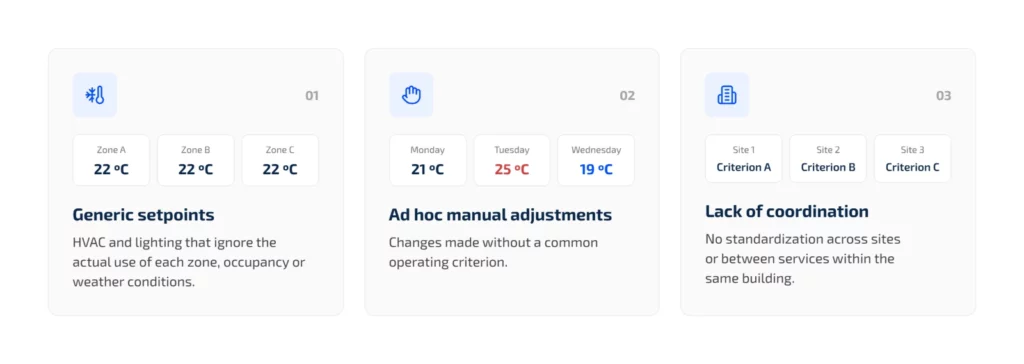
Several patterns recur in commercial buildings:
- Heating, cooling and lighting systems with generic setpoints that do not reflect how each zone is used, its occupancy or the weather.
- One-off manual adjustments without a common operating approach.
- Poor coordination and standardisation across sites or among the building’s own services.
A business energy monitoring system can reveal these patterns, but it cannot correct building operation on its own. Sustained reductions in consumption require a connection between data and control, automation and the practical ability to act on the systems.
What does building energy management involve?
Monitoring means recording and displaying variables such as energy consumption, power demand, temperature and equipment status. Management means using that information to decide how the building should operate and continually correct deviations.
In practice, managing energy means:
- Setting setpoints and operating rules by zone, schedule and conditions of use.
- Coordinating heating and cooling, lighting, ventilation and other systems so that they do not work against one another.
- Prioritising action when abnormal consumption, performance drift or equipment running outside scheduled hours is detected.
To understand this operational shift, it helps to look at what energy management software does and why it offers more than a data dashboard.
Control by zone and schedule
A building does not need the same conditions in every area or at every hour. Meeting rooms, corridors, reception areas and storage rooms serve different purposes and therefore have different requirements.
Zone-based control makes it possible to:
- Adjust temperature and lighting setpoints to how a space is actually used.
- Schedule equipment to switch on and off.
- Prevent equipment from running at full capacity in empty or lightly occupied zones.
To put these rules into practice, many facilities use a building management system (BMS), which centralises control around a defined operating strategy.
Real-time occupancy data
Integrating presence sensors, people counters and indicators such as CO₂ enables building systems to respond to actual occupancy rather than fixed estimates.
This information makes it possible to:
- Adjust ventilation and fresh-air supply to occupancy.
- Reduce heating and cooling demand when a zone is used less.
- Dim or adjust lighting while maintaining the intended comfort level.
This approach is also relevant to office air quality and predictive maintenance: it improves operations without making equipment work harder than necessary.
Automating critical equipment
A substantial share of building energy use comes from heating and cooling, refrigeration, ventilation, lighting and pumps. Improvements follow when these systems stop operating in the same way regardless of conditions and instead respond to defined control rules.
Building automation and proactive building systems can, for example:
- Give priority to more efficient equipment.
- Limit power demand to avoid peaks.
- Adjust setpoints in response to indoor and outdoor conditions.
- Detect abnormal operation and trigger maintenance actions.
The role of software in building energy management
Sensors and dashboards alone cannot deliver effective energy management. A software layer must connect monitoring, control and day-to-day operation.
This is where an EMOS (Energy Management and Optimization System) comes in. Unlike a solution focused solely on recording data, OTEA, the EMOS developed by EcoMT, connects energy information with control rules, automation and daily operations so that systems run according to defined criteria.
This principle is central to OTEA: monitoring without the ability to act does not change how facilities are managed. Seeing the data is not enough to change how a building operates; the data must be used to decide on and carry out adjustments to equipment.
What does comfort mean in a building?
In a commercial building, comfort is about more than temperature. It also includes stable indoor temperatures, air quality, appropriate lighting and fewer disruptions that affect building operations or the occupant experience.
Effective energy management therefore does not aim to cut consumption at any cost. It aims to maintain stable conditions for occupants while eliminating waste, poor settings and unnecessary operating hours.
What can effective energy management achieve?
When building operation combines monitoring, control and automation, it can reduce unnecessary energy use without compromising comfort. The actual impact depends on the building type, its starting point and the scope of the measures taken. Generic savings figures without context can be misleading.
In operational terms, effective energy management can:
- Reduce unnecessary operating hours.
- Detect deviations and abnormal energy use sooner.
- Apply consistent operating standards across one or more sites.
- Improve the stability of indoor conditions.
- Prioritise maintenance and investment using data on actual use.
These measures align with broader strategies to reduce electricity consumption in businesses while maintaining operational control.
Frequently asked questions about building energy management
What is building energy management?
It is the process of measuring, analysing and controlling a building’s energy consumption to reduce unnecessary use while maintaining appropriate indoor conditions.
What is the difference between monitoring and managing energy?
Monitoring means collecting and displaying data on consumption and comfort conditions. Managing means using that data to set rules, correct deviations and act on equipment.
Can you reduce energy use without compromising comfort?
Yes. The building needs to be operated according to zone, schedule and occupancy, with automation where appropriate, rather than using the same settings at all times.
What does an EMOS such as OTEA add?
A BMS focuses on controlling building systems. An EMOS such as OTEA connects monitoring, control and energy optimisation to turn data into operational decisions across one or more sites.
Where should you start?
Start with reliable monitoring, clear priorities and an initial set of operating rules for the equipment with the greatest impact on energy consumption and comfort.

Recommended for you


You deserve a facility management system that works with you
Request a free demo and discover how other maintenance, sustainability, and energy efficiency teams are achieving real results. No unnecessary complexity. Just a clear roadmap designed to scale with you.




