
Could office air quality be a sign that something is wrong?
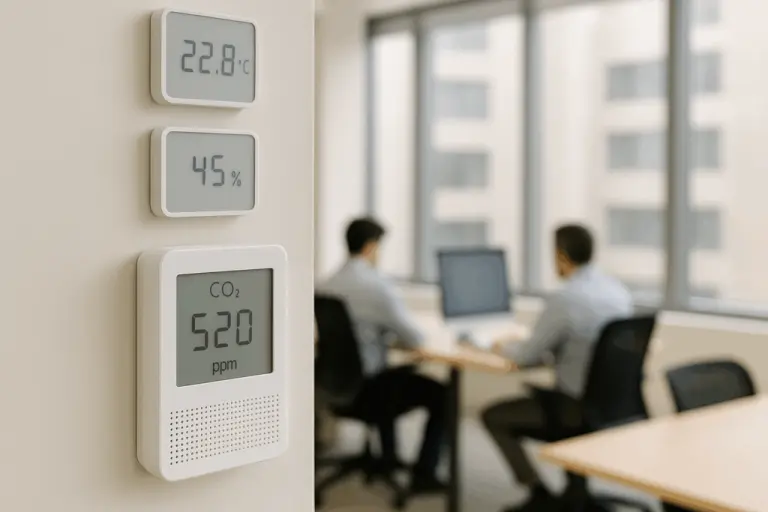
In many offices, it is enough for the environment to feel “strange” for complaints to begin: too much heat, stuffy air, feeling of heaviness. But what many people do not know is that this discomfort is not a coincidence: the air may be warning that something is not working well… and paying attention to it can help you avoid bigger problems.
Beyond comfort: the air also informs
Environmental comfort is not just a matter of well-being; It is also a very valuable source of information. A building that “speaks” through its data can anticipate breakdowns, improve its energy efficiency and take better care of the people who occupy it. Today, thanks to sensors connected to management platforms, it is possible to constantly measure parameters such as temperature, humidity or indoor air quality.
This data not only serves to adjust the climate more precisely, but also to detect failures before they become evident. Instead of waiting for someone to complain or a machine to fail, the building can automatically trigger an alert.
What can be monitored and why does it matter?
Here are three fundamental variables that help us understand the “state of health” of an office:
- Temperature: An abnormal increase or decrease can reveal everything from air conditioning problems to energy losses due to poor insulation. Furthermore, thermal comfort directly influences productivity.
- Humidity: Ideal levels are usually between 40% and 60%. Below, dry eyes and the feeling of cold increase. Above, fungi and bacteria proliferate. Humidity also affects how we feel the temperature.
- CO₂ (carbon dioxide): We do not see it or smell it, but its concentration has a direct impact on concentration and cognitive performance. Levels above 1,000 ppm indicate poor ventilation. Measuring it is key to knowing when and how to ventilate, without wasting energy.
Warning signs that we don’t see (but they are there)
Many problems in buildings go unnoticed until it is too late. But if we pay attention to the data, it is possible to get ahead.
- A meeting room where the CO₂ level rises rapidly every time there is a long meeting: this may be a clue that ventilation is not sufficient.
- A wing of the building that is always 2°C warmer than the rest: it can indicate a miscalibrated valve, a damaged sensor or a thermal leak.
- A spike in electricity consumption during a weekend when no one should be there: it could be a device that has been left on by mistake.
All these situations not only affect comfort, but also energy consumption and the useful life of the systems.
Savings and health go hand in hand
Controlling these variables is not just a technical issue, it is an intelligent strategy. The benefits are multiple:
- Energy: adjusting the air conditioning according to the actual use of the space avoids overheating or overcooling empty areas.
- Health: Better air quality reduces headaches, fatigue and respiratory symptoms, especially in sensitive people.
- Maintenance: detecting anomalous patterns prevents major failures, unplanned downtime or costly emergency interventions.
- Sustainability: more efficient management of the indoor environment reduces the energy footprint and contributes to companies’ ESG objectives.
Taking care of the air is taking care of people (and the building)
Ambient comfort has stopped being a luxury and has become a necessity. It is no longer enough to have an air conditioner that works: we need spaces that regulate themselves, that report their status in real time and that can be adjusted according to the actual use we make of them.
The good news is that the technology to do so already exists, and it is not a large investment, but rather a smart bet: for well-being, for savings and for sustainability.
And how is all this managed? The key is in platforms like OTEA
Having sensors spread throughout the building is great, but if there is no way to centralize, interpret and act on the data, all the potential is lost. This is where control platforms like OTEA make a difference.
Thanks to systems like this, you can not only view the status of each area of the building in real time or receive automatic alerts, but you can automate the response. That is, if the air quality exceeds a threshold, OTEA can automatically activate the appropriate ventilation systems, without human intervention.
This type of active intelligence makes OTEA more than just a management platform: it is a BMS (Building Management System) that acts as your eyes, ears and voice in the building. It detects, interprets and reacts, even when you are not there, allowing you total control with a high degree of efficiency, safety and comfort.

Recommended for you


You deserve a facility management system that works with you
Request a free demo and discover how other maintenance, sustainability, and energy efficiency teams are achieving real results. No unnecessary complexity. Just a clear roadmap designed to scale with you.




