
The UNE-EN ISO 52120-1 standard and its relevance to non-residential buildings

In the current context of energy demands and digital transformation in the tertiary sector, correctly applying the UNE-EN ISO 52120-1 standard is not only a good technical practice, but a key strategy to optimize the performance of buildings and guarantee the traceability of their automation systems.
This standard, which is part of the European EPB (Energy Performance of Buildings) set, establishes an objective methodology to evaluate the functional level of BACS (Building Automation and Control Systems) systems. Its purpose is not to establish direct savings measures, but to technically classify the capacity of a BACS system to contribute to the energy performance of the building.
What does the UNE 52120 standard really regulate?
UNE-EN ISO 52120-1 is part of the set of EPB (Energy Performance of Buildings) standards and establishes the framework for evaluating the functional level of building automation and control systems (BACS).
It’s not just about having sensors or timers. The standard classifies your system according to its real capacity to contribute to energy savings, into four levels: Class D, without automation or with obsolete systems; Class C, basic control (e.g. manual on/off); Class B, efficient and adaptive automation; and Class A, advanced system with integrated energy optimization.
The greater the functional leap (for example, from C to B or from D to A), the greater the technical potential for optimized energy management. This class change can be used as a calculation basis in instruments such as the TER050 factsheet to generate CAEs.
What impact does UNE-EN ISO 52120-1 have on energy efficiency?
The UNE-EN ISO 52120-1 standard does not prescribe specific energy saving measures, nor does it establish quantifiable consumption objectives. Its purpose is to provide a methodology for evaluating the functionality of building automation and control systems (BACS) in relation to their ability to contribute to the overall energy performance of the building.
This regulatory approach translates into a functional classification of the BACS system into four levels (Class D, C, B and A), which reflect the degree of automation, supervision, interoperability and adaptive control of the installed system. As we mentioned above, the higher the functional level, the more capable the system is of supporting efficient and optimized energy management.
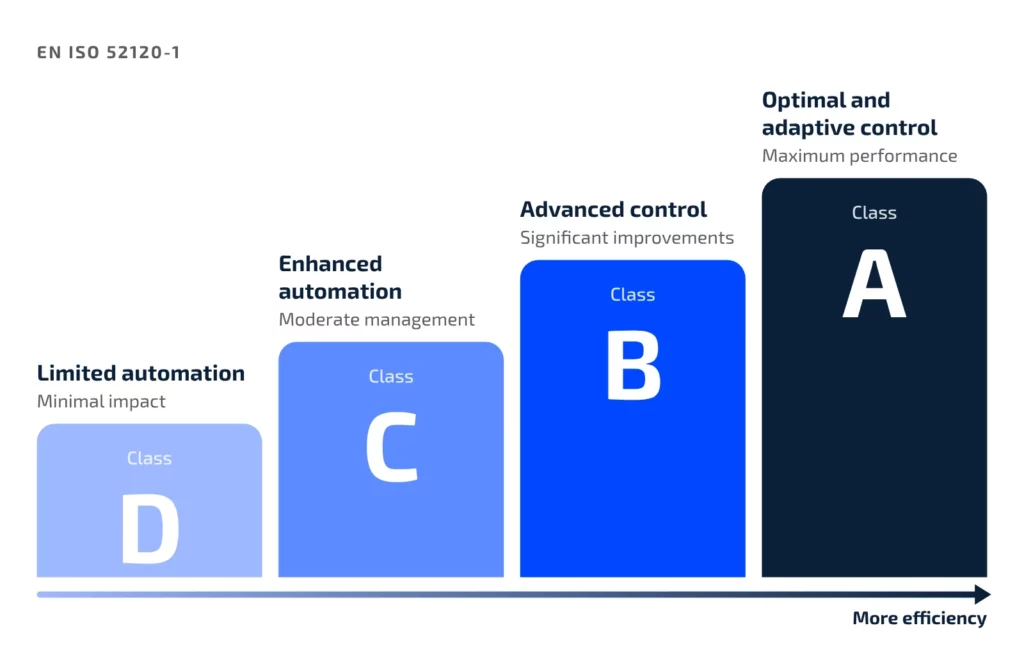
In this sense, a BACS system that aspires to a class B or A must comply with adequate functionalities.
- Automatic adjustment of air conditioning, lighting or ventilation based on dynamic variables such as actual occupancy, outdoor conditions or the building’s energy specifications.
- Demand-based control capacity, allowing adaptive responses to real usage needs.
- Continuous and centralized monitoring of all subsystems to ensure consistency in operation (for example, preventing an air conditioning system from working excessively when there is passive solar input).
- Interoperability between equipment and systems, an essential requirement to achieve high functional levels.
Although the standard does not directly establish energy savings in terms of kWh, the implementation of a system with a high functional level according to UNE 52120 creates the necessary technical conditions to reduce energy consumption, improve comfort and increase the operational stability of the building.
In addition, having a system that allows structured monitoring and centralized control of energy consumption opens the door to other indirect advantages:
- Optimization of operating costs thanks to the reduction of unnecessary consumption.
- Improvement in technical decision making based on traceable data.
- Technical support for preventive or predictive maintenance strategies.
- It facilitates compliance with environmental commitments and ESG criteria, by having a reliable and audited technical base.
How is this standard applied in the TER050 factsheet?
The TER050 factsheet, part of the national catalog of the CAE system, establishes how the theoretical energy savings that can be converted into CAEs are calculated. This calculation is based on the functional class improvement according to UNE 52120, without the need for real consumption measurements.
To validate this class change, you only need functional diagrams of the installed system, images of the installation and a technical declaration of the level achieved (issued by the engineer or installer). This is where having a platform like OTEA facilitates the documentary process and improves the technical traceability of the entire automated system.
What do you achieve by automating under UNE 52120?
Adopting this standard is not just a matter of compliance: it has an immediate operational and economic impact. With a BACS system aligned with UNE 52120 and well connected to a management platform such as OTEA, you can achieve lower energy consumption and fewer incidents, since automation reduces human errors and allows predictive actions.
In addition, you will have useful and traceable data to audit consumption, justify decisions and respond to ESG demands. You will also be able to obtain liquidity without depending on subsidies, because documented savings are transformed into marketable CAEs. And finally, you will improve the perception of sustainability of your building, gaining value for clients, tenders and investors.
At OTEA we make it easy
At OTEA we are the technological ally you need to intelligently manage the energy and maintenance of your facilities, with guarantees of regulatory compliance and tangible results from day one.
We provide the platform, data and support necessary for your system to not only automate, but also control, measure, detect, optimize and justify energy savings in accordance with the UNE 52120 standard and the TER050 factsheet.
We ensure that the systems connected to OTEA meet the required functional requirements and are correctly documented to facilitate technical validation. Plus, we help you transform all that data into smart decisions and measurable savings.
We know that moving between regulations, digitalization and sustainability can be complex. That is why we offer a unified platform, with the capacity to centralize automation, remote management, energy efficiency, remote maintenance and ESG analysis.
We have already done it in dozens of buildings in the tertiary sector, and each project is a new opportunity to demonstrate that energy efficiency does not have to be complicated when you have the right tools.

Recommended for you

You deserve a facility management system that works with you
Request a free demo and discover how other maintenance, sustainability, and energy efficiency teams are achieving real results. No unnecessary complexity. Just a clear roadmap designed to scale with you.




