
What are energy savings certificates and how do they benefit businesses in 2026?

In a context where energy efficiency is key to the competitiveness and sustainability of companies, Energy Savings Certificates (CAEs) have emerged as a fundamental tool to transform energy savings into a financial asset. In a world where energy costs continue to rise and environmental regulation is increasingly strict, finding mechanisms that convert efficiency into profitability is a priority for any organization.
CAEs not only represent an opportunity to reduce the environmental impact and improve the energy management of buildings, but they also open the door to new sources of income by monetizing each kWh saved. Companies in all sectors are beginning to adopt these certificates as part of their cost optimization and regulatory compliance strategy, making the most of the available incentives.
But do you really know its full potential for the tertiary sector? From offices and hotels, to hospitals and shopping centers, passing, of course, to fashion stores or supermarkets. And more and more companies are discovering that CAEs can make the difference between an investment in energy efficiency with a long-term return and a profitable strategy with immediate benefits.
What are CAEs and how do they benefit companies?
The Energy Saving Certificates (CAEs) are electronic documents that officially certify the final energy savings achieved thanks to an energy efficiency measure. Every 1 kWh saved becomes a CAE, allowing companies to not only reduce their operating costs but also monetize energy savings by selling these certificates on a regulated market.
The CAEs system emerges as an innovative alternative within energy efficiency policies, making it easier for companies to recover part of their investment in savings projects. In this way, in addition to the direct impact on the energy bill, CAEs function as a financial instrument that generates an additional flow of income.
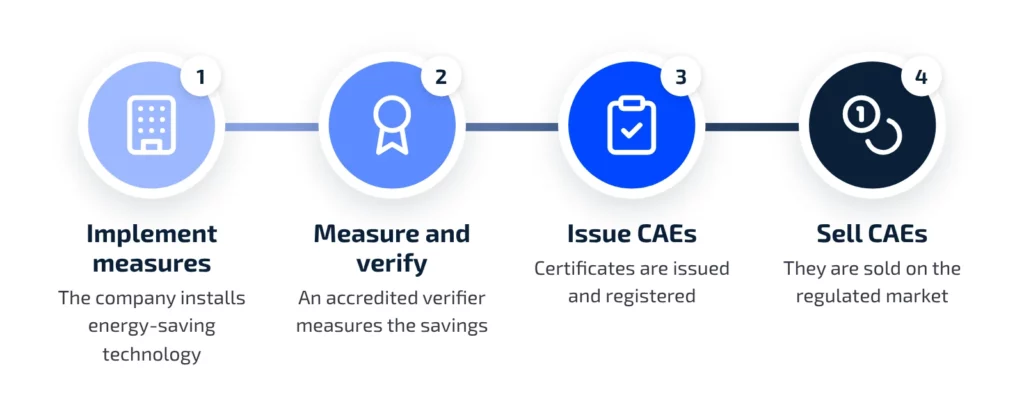
How are these certificates generated and validated?
The process of generating and validating Energy Savings Certificates (CAEs) follows a structured procedure that guarantees the transparency and traceability of the energy savings obtained.
1. Implementation of an energy efficiency measure
It all begins with the execution of an energy saving action, which can range from the installation of high-efficiency LED lighting, the modernization of air conditioning systems with advanced technologies, to the integration of automation and control systems (BACS) in tertiary buildings. These measures must comply with the technical requirements established in the standardized measure factsheets or, failing that, undergo an individual evaluation if it is a singular action.
2. Measurement and verification
To guarantee that energy savings are real and quantifiable, a verifier accredited by ENAC (National Accreditation Entity) must analyze the impact of the implemented measure. This process includes the collection of consumption data before and after the intervention, the application of recognized calculation methodologies and the validation that the savings achieved are attributable to the measure implemented.
3. CAE issuance
Once the savings are verified, the certificate is issued. The competent administration, generally at the regional level, reviews the documentation presented and grants the corresponding CAEs. Each certificate represents 1 kWh of annual savings and is registered in the National System of Energy Efficiency Obligations (SNOEE), ensuring its traceability within the energy market.
4. Marketing
With the CAEs in their possession, companies can sell them on the market to obligated entities, which are mainly electricity, gas suppliers and oil product operators. These companies must comply with their annual energy savings quotas and, to do so, they can purchase CAEs instead of making direct contributions to the National Energy Efficiency Fund (FNEE).
In addition, the system allows the participation of delegated entities, which are entities accredited to manage CAEs on behalf of the obligated entities or other interested companies. These intermediaries facilitate the processing, finance projects in exchange for the certificates and help maximize the value of the CAEs in the market.
The sale of CAEs can be carried out through direct agreements with obligated entities or through delegated entities, which allows companies to choose the most convenient strategy according to their management capacity and financial needs.
Key benefits of CAEs
The Energy Savings Certificate System (CAEs) has become an essential tool for companies seeking to optimize their energy consumption, reduce costs and align with regulatory requirements. Beyond their economic impact, CAEs represent an opportunity to modernize facilities and move toward a more sustainable and competitive model.
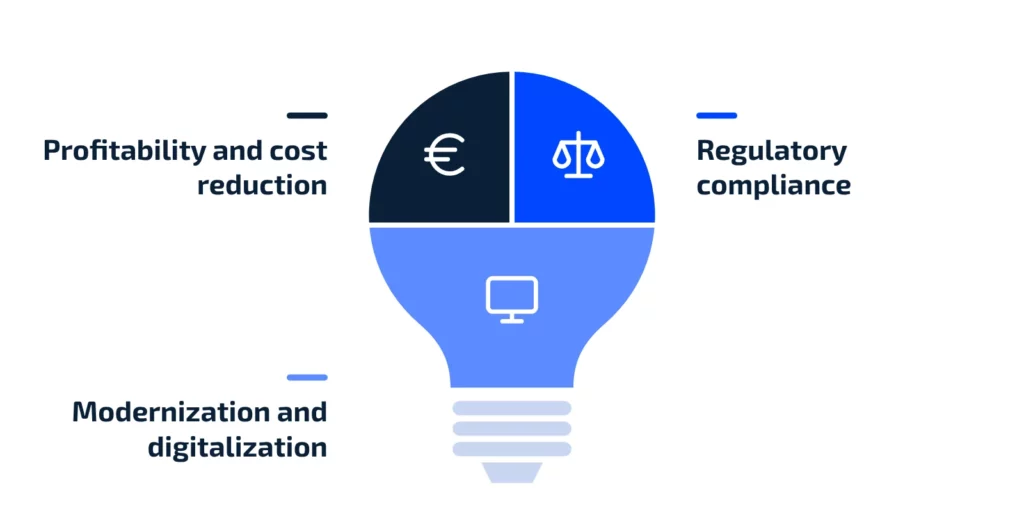
Profitability and cost reduction
Each kWh saved not only reduces the electricity or gas bill, but can also become additional income through the sale of CAEs on the market. This mechanism makes investments in energy efficiency more profitable, as it accelerates the return on investment and generates a complementary income stream.
In addition, the reduction of energy consumption optimizes the performance of systems such as lighting, air conditioning and industrial processes, minimizing operational and maintenance costs, extending the useful life of the equipment and improving the general efficiency of the facilities.
Regulatory compliance
Regulation regarding energy efficiency is increasingly demanding. The CAEs help companies to comply with the legal obligations established in national and European regulations, such as the Regulation of Thermal Installations in Buildings (RITE) or the requirement to have automation systems in large tertiary buildings before 2025. In this way, sanctions are avoided and alignment with decarbonization and sustainability strategies is guaranteed.
Modernization and digitalization
Energy efficiency not only means reducing consumption, but also better managing resources. The integration of advanced technologies, such as automation and control systems (BACS), allows companies to monitor energy consumption in real time, optimize their operation and detect inefficiencies proactively. This facilitates the digitalization of buildings and contributes to the evolution toward smart and sustainable environments.
Regulatory framework in Spain: keys for 2025
The Energy Savings Certificate System (CAEs), regulated by Royal Decree 36/2023, establishes a market in which electricity, gas and other obligated entities can acquire these certificates as an alternative to their contribution to the National Energy Efficiency Fund (FNEE). This model, aligned with European guidelines, encourages investment in energy efficiency by monetizing the savings obtained, allowing companies to recover part of their investment in energy improvements.
What changes in 2025?
Starting in 2025, the system will be fully operational, consolidating a new dynamic of incentive for energy savings. This means that:
- Companies that have implemented efficiency measures since January 2023, as well as those that do so in 2024, 2025 and onwards, may request the issuance of their CAEs.
- These certificates can be sold on the market, offering companies an additional financial return for their investments in energy efficiency.
- The savings verification and certification system will be fully developed, facilitating access to the CAEs for any company that meets the regulatory requirements.
In this context, the implementation of energy efficiency measures ceases to be just regulatory compliance and becomes a profitable economic strategy, where each kWh saved translates into a reduction in costs and a new source of income.
Catalog of standardized measures: a key reference
The regulatory framework establishes a Catalog of Standardized Measures, developed by the Ministry for the Ecological Transition and the Demographic Challenge. This catalog is essential to expedite the certification of savings and facilitate the issuance of CAEs. It includes technical sheets that detail:
- Calculation methodologies to determine the energy savings of each type of action, such as LED lighting, efficient air conditioning or building automation.
- Certification criteria that allow savings to be converted into CAEs in a systematic and verifiable manner.
- Verification procedures to ensure the validity of declared savings.
The use of this catalog simplifies the process for companies, since, as they are predefined measures, the calculation of savings and certification are faster and more accessible.
Regulatory compliance and framework of obligations
In 2025, companies in the tertiary sector will have to comply with new energy efficiency regulations that require the incorporation of advanced technologies to optimize consumption. Among the most relevant requirements is the obligation to install automation and control systems (BACS) in buildings with an installed thermal power greater than 290 kW, in compliance with the Regulation on Thermal Installations in Buildings (RITE).
This type of system allows for more efficient consumption management, automatically adjusting the use of air conditioning, ventilation and lighting based on actual occupancy and energy demand. This is not only a legal requirement, but an opportunity to reduce operating costs and generate additional income through CAEs.
Companies that do not adapt in time may face inspections, sanctions and increased energy expenditure due to inefficiencies in their facilities. On the other hand, those that comply with the regulations will not only avoid risks, but will also be able to benefit from economic incentives, improve their operational efficiency and reinforce their sustainability positioning.
TER050 factsheet: the key to automation in tertiary buildings
Within the Energy Savings Certificate System (CAEs), the TER050 factsheet plays a key role in the modernization of the tertiary sector, promoting the adoption of automation and control systems (BACS). These systems optimize energy consumption by intelligently managing infrastructure such as air conditioning, lighting and domestic hot water, adjusting their operation to the occupancy and real needs of the building.
In addition to improving operational efficiency and reducing waste, the installation of a BACS is a regulatory requirement. The Regulation on Thermal Installations in Buildings (RITE) establishes that large buildings must incorporate these systems before 2025. Its implementation not only guarantees legal compliance, but also improves thermal and lighting comfort and facilitates centralized management of the building.
Profitable automation: certified and monetizable savings
Beyond energy efficiency and sustainability, the TER050 factsheet turns automation into an economically viable investment. By implementing a BACS, companies can certify the energy savings achieved and monetize it through CAEs allowing them to obtain CAEs, or making the project profitable.
• Obtain Energy Savings Certificates, which can be sold on the market to obligated entities, generating additional income.
• Reduce the payback period, facilitating the profitability of the project.
In this way, building automation not only responds to a regulatory requirement, but also becomes an opportunity to save, modernize and generate income, ensuring more intelligent and sustainable energy management.
Use cases: how CAEs are transforming the tertiary sector
The impact of Energy Savings Certificates (CAEs) in the tertiary sector is increasingly evident, allowing companies in different areas to reduce their energy costs and, at the same time, obtain additional income from their certified savings. Let’s look at some concrete examples that illustrate its potential.
In the case of offices, modernizing the lighting system, replacing fluorescents with LED technology, makes it possible to significantly reduce electricity consumption. This savings can be certified as CAEs, generating a new source of income without the need to make complex investments.
In the hospitality sector, the implementation of BACS systems in air conditioning and ventilation optimizes energy consumption. This type of automation not only reduces operating costs, but also improves the customer experience, guaranteeing optimal thermal comfort without wasting energy in unoccupied rooms or common areas.
For their part, shopping centers can benefit from CAEs through the modernization of their refrigeration and air conditioning systems. These improvements not only reduce electricity consumption, but also increase operational efficiency, extending the useful life of the equipment and improving business profitability.
Challenges and considerations to take into account
Despite the numerous benefits offered by the Energy Savings Certificate System (CAEs), its adoption entails certain challenges that companies must consider to maximize their profitability and ensure efficient implementation.
One of the main challenges is the complexity of the administrative process. For an energy saving measure to be certified and converted into CAEs, it is necessary to present detailed technical documentation, which includes savings calculations, project characteriztics and evidence of its real impact. In addition, this data must be validated by an accredited independent verifier, which adds an additional level of demand to the processing.
Another key factor is the initial investment. Although the CAEs allow you to recover part of the expense incurred, the company must assume the total cost of the project in advance before beginning to receive the economic benefits from the sale of the certificates. This can represent a barrier for organizations with liquidity limitations, especially if the return on investment is projected in the medium or long term.
In this context, delegated entities can play a fundamental role in facilitating access to CAEs. These accredited entities can manage the complete processing of the certificate on behalf of the companies, reducing the administrative burden and streamlining the processes. Furthermore, in some cases, the delegated entities can offer partial or total financing of the project in exchange for the CAEs generated, allowing companies to benefit from the system without having to face the entire initial investment.
Finally, market volatility is an aspect that cannot be ignored. The value of CAEs depends on supply and demand in the energy market, which means that their price can fluctuate. Although in theory it should remain below the cost of contributions to the National Energy Efficiency Fund (FNEE), the final profitability of the certificates may be affected by external factors, such as regulatory changes or the evolution of energy prices.
Despite these challenges, the CAE System continues to be a key tool to promote energy efficiency and make sustainable projects profitable. With adequate planning, the support of delegated entities and correct management of the process, companies can minimize the risks and maximize the benefits offered by this mechanism.
How to take advantage of this opportunity?
Energy Savings Certificates are a powerful tool to improve the profitability and sustainability of the tertiary sector. Making the most of its potential requires planning, investment in efficient technology and detailed knowledge of the system. At OTEA we are here to help you take the leap toward intelligent and profitable energy management!
Ready to optimize your company’s consumption and generate additional income? Contact us and discover how CAEs can boost your energy strategy in 2025.
Success Story: Energy Automation with a BACS System in a Supermarket Chain
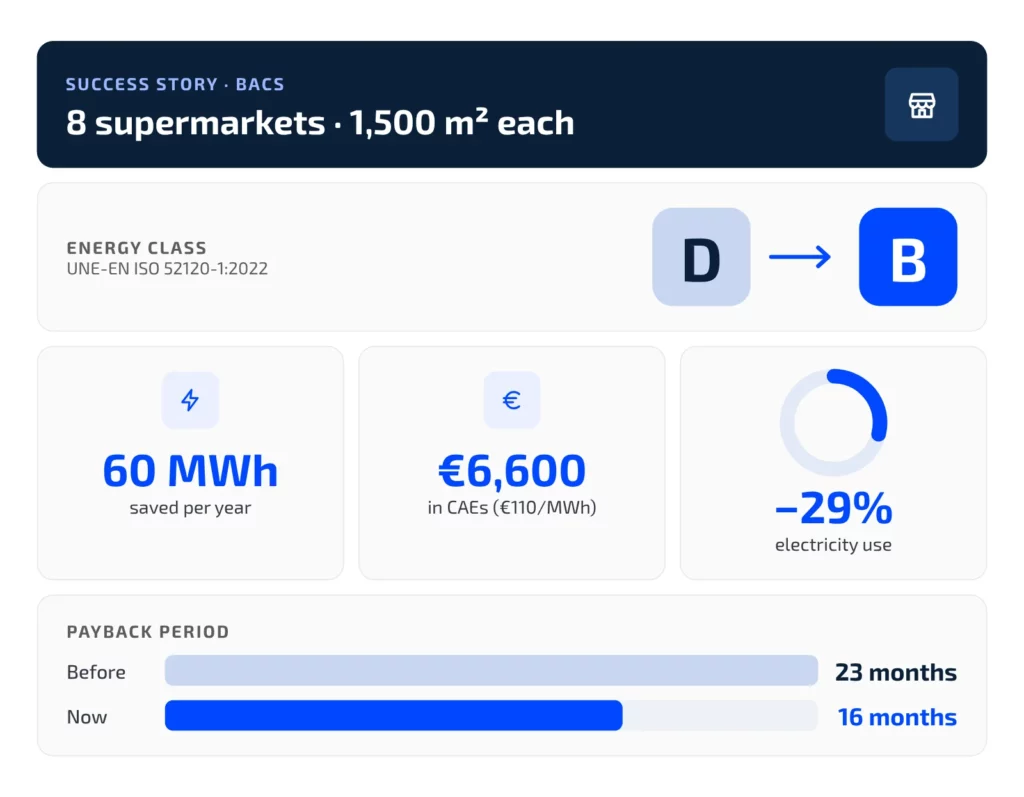
A supermarket chain has implemented a BACS system in accordance with the TER050 factsheet at eight of its stores, with an average floor area of 1,500 m² per store. The project integrated automated control of heating, cooling and lighting, improving the buildings’ energy efficiency from class D to class B under the UNE-EN ISO 52120-1:2022 standard.
This improvement resulted in a reduction in energy consumption of 60 MWh/year, certified in accordance with the standardised procedure set out in the TER050 factsheet. These savings generated Energy Savings Certificates (CAE) worth €6,600, based on a market price of €110/MWh.
In addition to the direct income from CAEs, the project delivered a 29% decrease in annual electricity consumption, improving comfort and digitalising the facilities for remote management through the OTEA platform. The payback period fell from 23 to just 16 months, demonstrating the economic viability of this type of project when aligned with the CAE scheme.
This case illustrates how the combination of technology, regulatory standards and a control platform such as OTEA can turn energy management systems into an effective driver of savings and sustainability for the tertiary sector.

Recommended for you



You deserve a facility management system that works with you
Request a free demo and discover how other maintenance, sustainability, and energy efficiency teams are achieving real results. No unnecessary complexity. Just a clear roadmap designed to scale with you.




